Greyhound Derby Bet Types: Forecast, Tricast and More
Best Greyhound Betting Sites – Bet on Greyhounds in 2026
Loading...
Six Dogs, Dozens of Ways to Bet
A six-dog race is the sweet spot for exotic bets. In a sixteen-runner horse racing handicap, naming the first two home in the correct order means sifting through 240 possible combinations. In a Greyhound Derby heat, the same straight forecast has just 30 possible outcomes. A tricast — first, second and third in order — has 120 permutations in a six-dog field compared to 3,360 in a sixteen-runner race. The maths alone makes greyhound racing, and the Derby in particular, a more tractable environment for forecast and tricast betting than almost any other racing product available in the UK.
Yet most Derby punters stick to win bets. They back a dog to finish first and either collect or lose. That is a perfectly valid approach, but it ignores a range of markets that can be more profitable, more entertaining, and in some cases structurally better suited to the realities of Derby racing. Each-way bets offer a safety net when the ante-post place terms are generous. Forecasts reward punters who can identify the likely first two in a competitive heat. Tricasts deliver outsize returns when three dogs can be separated from the rest. And multiples allow you to link selections across heats on the same card, compounding small edges into larger returns.
This is the full menu of bet types available on the English Greyhound Derby — what they are, how they work, what they cost, and when each one makes sense. The Derby’s six-dog fields make every exotic market accessible. The question is not whether you can use them, but whether you know which one to reach for at each stage of the competition.
Win and Place Bets
A win bet is the simplest wager in greyhound racing: you pick a dog, you stake your money, and if it crosses the line first, you collect your return at the agreed odds. If it finishes second or worse, you lose your stake. There is nothing to calculate beyond the price and the profit. A five-pound win bet at 4/1 returns twenty pounds profit plus your five-pound stake — twenty-five pounds total. That clarity is the bet’s appeal, and it is the reason win bets account for the majority of greyhound wagers placed in the UK.
The decision that most punters handle poorly is whether to take an early price or wait for the starting price. The starting price — the SP — is the final price offered by the on-course market at the moment the traps open. If you take a fixed price with your bookmaker an hour before the race and the SP ends up higher, you have lost value. If the SP is lower, you have gained it. Best Odds Guaranteed policies, where available, resolve this dilemma: you take the early price, and if the SP is better, you receive the higher payout automatically. Where BOG is not available — and not all bookmakers extend it to every greyhound meeting — you must decide whether to lock in a price or gamble on the SP.
For Derby heats, where markets can be volatile in the minutes before the off, taking a price is usually the better discipline. The market for a specific heat can shift sharply when late money arrives, and the SP may end up shorter than the price you could have taken half an hour earlier. For the final, where the market has been scrutinised for days and the prices are more stable, the case for waiting is slightly stronger — but even then, if you see a price you consider value, take it. Waiting for a better price that never materialises is one of the quietest ways to lose edge.
Place bets are the win bet’s understated sibling. A place bet pays out if your dog finishes in one of the designated place positions — in a six-runner greyhound race, that means first or second. Place odds are calculated as a fraction of the win odds: typically one-quarter the odds for a standard six-dog race. So a dog at 8/1 to win pays 2/1 for a place. Place-only bets are less common than each-way bets, which combine win and place into a single wager, but they have a role in situations where you rate a dog to run well without necessarily winning — a dog with strong form that faces a faster rival but should still finish in the first two.
Each-Way Betting in the Derby
An each-way bet is two bets in one: a win bet and a place bet, at equal stakes. If you place a five-pound each-way bet, your total outlay is ten pounds — five on the win and five on the place. If the dog wins, both legs pay out. If it finishes second (in a standard six-runner field), the win leg loses but the place leg pays at one-quarter the win odds. If it finishes third or worse, both legs lose.
The maths determine when each-way betting is worthwhile. For the place leg to offer value in a six-runner race with 1/4 odds and two places, the win price generally needs to be 5/1 or longer. At shorter prices, the place return is too small to justify the doubled stake. At 5/1, the place leg pays 5/4 — better than even money on a dog that needs to finish in the top two of a six-dog field. At 8/1, the place leg pays 2/1. At 12/1, it pays 3/1. The longer the win price, the more the place leg becomes a bet worth having in its own right, not just a consolation prize for a near-miss.
The Derby’s ante-post outright market offers a different each-way proposition entirely. Some bookmakers pay extended places on the outright winner market — four, five, or even six places, which in a Derby context effectively means paying out on every dog that reaches the final. An each-way bet at 25/1 with six places and 1/4 odds gives you a place leg at 25/4 (just over 6/1) on your dog simply making the six-dog final. If you believe a 25/1 shot has a realistic chance of qualifying through the rounds — even without winning the whole thing — the place element alone can deliver a substantial return. This makes ante-post each-way one of the most structurally attractive bets in the entire Derby calendar, and it is routinely underused by punters who think of each-way only in terms of individual race place terms.
Each-way betting requires a shift in how you evaluate selections. A win-only punter asks: “Will this dog win?” An each-way punter asks: “Will this dog finish in the places, and is the place return worth half my total stake?” They are different questions with different answers. A dog that is unlikely to win a loaded semi-final but has the class and pace to finish second is a poor win bet and a potentially excellent each-way bet — provided the odds are long enough for the place leg to pay.
Forecast Bets: Straight, Reverse and Combination
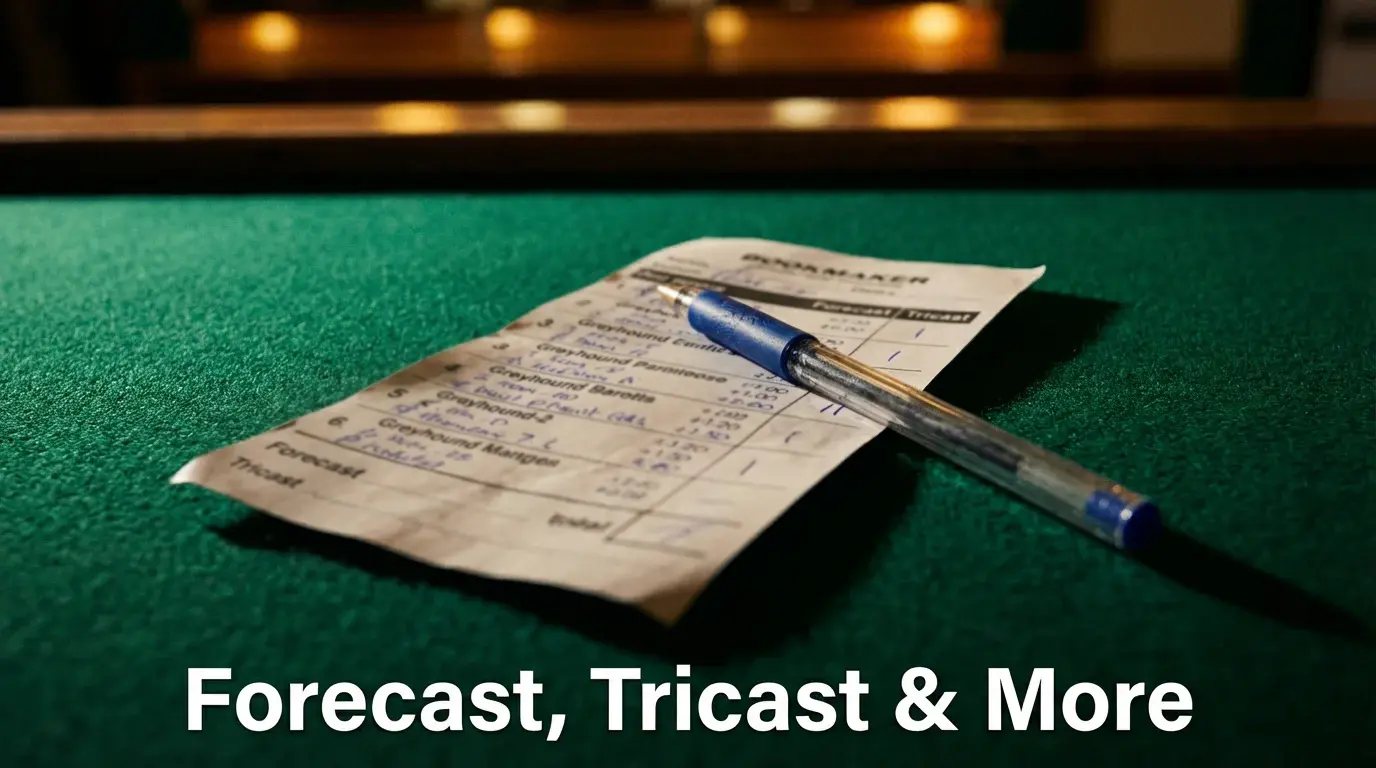
A forecast bet requires you to predict the first two finishers in a race. If you get both dogs right, in the correct order, the payout is determined by the Computer Straight Forecast dividend — a formula calculated from the starting prices of the first two home. The CSF dividend is declared after the race and is the same regardless of which bookmaker you placed your bet with. It is a pool-style calculation applied to fixed-odds forecasts, and the returns can be significant: a forecast combining a 4/1 first with a 6/1 second might pay anywhere from 25/1 to 40/1 or more, depending on the specific dividend.
In a six-dog Greyhound Derby heat, forecast betting is more viable than in almost any other racing context. With only six runners, there are 30 possible exact-order combinations for the first two home. Compare that to a twelve-runner horse race, where the number is 132. The smaller field compresses the probability space and makes informed selection — based on form, draw, and running style — a genuinely productive exercise rather than a speculative one.
Straight Forecast Mechanics
A straight forecast is the simplest forecast variant. You name the dog you expect to finish first and the dog you expect to finish second, in that order. One bet, one unit stake. If your first selection wins and your second selection finishes second, you collect the CSF dividend multiplied by your stake. If either dog finishes in the wrong position, or if a different dog fills one of the two spots, the bet loses.
The skill in straight forecast betting lies in identifying not just the winner but the most likely runner-up — and that is a different form assessment. The winner is typically the fastest or most favourably drawn dog. The runner-up is the dog that has the pace to compete without quite having the edge to win. In a Derby heat, that often means a dog with strong early speed from an inside draw finishing behind a slightly faster rival, or a closer who runs on well but cannot catch the leader. Reading the likely race shape — who leads, who follows, who fades — is the analytical core of forecast betting.
Straight forecasts carry more risk than win bets, because you must be right about two outcomes rather than one. The compensation is the payout. A Derby heat where the first two home are both reasonably fancied might produce a CSF of 15/1 to 25/1. A heat where the runner-up is an outsider can produce dividends of 60/1 or more. These returns dwarf what a win bet on the favourite would have delivered and make forecasts the primary tool for punters who want to leverage their form knowledge into larger payouts from modest stakes.
Combination Forecasts for Better Coverage
A reverse forecast covers both possible finishing orders of two named dogs. If you select Dog A and Dog B, the reverse forecast pays out whether A finishes first and B second, or B finishes first and A second. It costs two units — one for each permutation — and the payout is the CSF dividend for whichever order occurs. This is the obvious step up from a straight forecast when you are confident about the two dogs involved but uncertain which will finish ahead of the other.
A combination forecast extends the coverage further. You select three or more dogs, and the bet covers every possible first-and-second combination among them. Selecting three dogs produces six permutations (and costs six units). Selecting four dogs produces twelve permutations. Five dogs: twenty. The cost scales quickly, so combination forecasts work best with three or four selections — enough to cover the realistic contenders without the stake ballooning to a point where only a large dividend justifies the outlay.
In a competitive Derby semi-final where three dogs look capable of filling the first two positions, a three-dog combination forecast at a one-pound unit stake costs six pounds and covers every possible first-second combination among your three. If any two of your selections finish first and second, you collect the CSF. The trade-off is that you need the dividend to exceed six times your unit stake to make a profit — which, in a semi-final with closely matched runners, it may or may not do. The combination forecast is a tool for coverage, not for maximising returns on a strong opinion. Use it when the form points to a group of contenders rather than a clear first and second.
Tricast and Combination Tricast Bets
A tricast requires you to predict the first three finishers in the correct order. It is the forecast’s more ambitious cousin, and in most racing contexts it is a low-probability, high-reward punt that even experienced punters treat with caution. In a Greyhound Derby heat, however, the six-dog field changes the arithmetic. There are 120 possible exact-order combinations for the first three home — a large number, but not an unmanageable one. For context, the same bet in a twelve-runner horse race has 1,320 possible outcomes. The six-dog field makes tricasts a genuine form exercise rather than a lottery ticket.
The payout is calculated via the Computer Tricast dividend, which works on the same pool-based formula as the CSF but typically produces significantly larger returns. A Derby heat tricast where the first three are all reasonably fancied might pay 80/1 to 150/1. A heat where the third dog is an outsider can push the dividend above 300/1. These are the kinds of returns that turn a two-pound stake into a meaningful sum, and they are achievable more often than the raw probability suggests — because you are not selecting at random. You are using form, draw, and running-style analysis to narrow 120 permutations down to a handful of realistic outcomes.
A combination tricast selects three or more dogs and covers every possible first-second-third permutation among them. Selecting three dogs produces six permutations (3 x 2 x 1). Selecting four dogs produces 24. Five dogs: 60. The cost escalation is steep, which is why combination tricasts work best with three or four selections. A three-dog combination tricast at one pound per line costs six pounds and covers every possible ordering of your three chosen dogs. If all three finish in the first three positions — in any order — one of your permutations will land.
The question is whether the expected dividend justifies the cost. In a tightly contested Derby semi-final where three dogs stand out from the field, a six-pound combination tricast needs a dividend of only seven or eight times your unit stake to produce a profit. Given that semi-final tricast dividends routinely exceed that threshold, the maths often works — provided your three selections are the right three. The discipline is the same as with any exotic bet: the tool is sound, but it only delivers when the form analysis underneath it is accurate.
Tricasts are best deployed in heats and semi-finals where the form separates three dogs from the rest. In those situations, the probability of your three selections finishing first, second and third — in some order — is meaningfully higher than the raw 6-in-120 baseline, and the dividend rewards you for being right about a difficult prediction. In the final, where all six dogs are closely matched and any of them could fill any position, the probability distribution is flatter and the tricast becomes more speculative. Use it where the form gives you an edge in identifying the top three, not where the form says all six are equally likely.
Multiples and Accumulator Bets
Derby heats often run in batches — three, four, or more heats on the same evening card. This creates a natural temptation to link selections across heats in a multiple bet: a double (two selections), a treble (three), or a larger accumulator. The appeal is compounding odds. If you back three dogs at 3/1 each in separate heats, a treble returns roughly 63/1 — far more than the sum of three individual win bets. The risk, as always with multiples, is that every leg must win. Three strong selections with a 30% individual win probability produce a treble with about a 2.7% chance of landing.
The disciplined use of multiples in Derby betting comes down to accepting that trade-off and sizing your stakes accordingly. A one-pound or two-pound treble across three heats where you have strong form views is a controlled bet with a known downside and a potentially large upside. A twenty-pound accumulator across five heats is a bankroll liability that the maths do not support. The rule of thumb is to stake multiples at a fraction of your standard single-bet stake — typically a quarter or less — and to treat the returns as a bonus rather than a foundation of your Derby betting.
Full-cover bets offer a middle path between singles and accumulators. A Trixie covers three selections with three doubles and one treble — four bets total. If two of your three selections win, you collect on one double and recoup some of your outlay. If all three win, you collect on all three doubles and the treble. A Patent adds three singles to the Trixie, giving you a return from a single winner. A Yankee covers four selections in six doubles, four trebles, and one four-fold. These structures spread the risk across multiple combinations, reducing the all-or-nothing nature of a straight accumulator while preserving the compound-odds potential when multiple selections land.
For Derby betting specifically, a Trixie across three heats on the same card is a practical multiple. It costs four units, it delivers a return from any two winners, and it pays significantly more if all three come in. It is the multiple that best balances risk and reward in a format where you are betting on several heats in a single session. Avoid larger full-cover bets like Yankees or Super Yankees unless your Derby budget is generous enough to absorb the higher unit cost without affecting your core single-bet staking.
The Right Bet at the Right Moment
The best bet type for the Derby changes as the competition progresses. In the ante-post market, weeks before the first heat, the outright each-way bet at extended place terms is the standout option — long prices, generous place coverage, and a structural advantage that no other Derby stage offers. During the early rounds, win bets on individual heats are the cleanest way to back dogs whose form you have analysed against the specific opposition they face. As the competition narrows into the quarter-finals and semi-finals, forecasts become increasingly viable because the quality compression of the surviving field makes the first-two prediction more tractable. Tricasts work best in semi-finals where three dogs separate themselves from the other three. And in the final itself, a simple win bet — backed by six weeks of accumulated form data — is hard to beat for directness and efficiency.
The mistake is using the same bet type at every stage. Punters who place win bets on everything miss the ante-post each-way value and the forecast opportunities in the later rounds. Punters who chase forecasts and tricasts in every heat are paying a coverage premium that the early-round form data does not yet justify. The Derby is a six-week event, and the bet types available to you are tools — each designed for a specific job. Use them accordingly.
Six dogs. Thirty forecast combinations. A hundred and twenty tricast permutations. A market that opens weeks before the final and closes seconds before the traps rise. The Derby gives you more ways to bet than any standard meeting, and the small fields make every one of those options more accessible than their horse racing equivalents. The punters who profit are the ones who know which tool to pick up and, just as importantly, which to leave in the box.