UK Greyhound Derby Betting: Odds, Tips and Strategy Guide
The complete guide to English Greyhound Derby betting — odds, tips, ante-post strategy, trap statistics, bet types and expert insights for Towcester 2026.
Best Greyhound Betting Sites – Bet on Greyhounds in 2026
Loading...
The Biggest Night in British Dog Racing
The English Greyhound Derby is not just another race on the BAGS calendar. It is the single most significant betting event in British greyhound racing — a six-round knockout tournament that begins with 192 entries and compresses to a six-dog final over the course of six weeks. No other event in the sport generates the same depth of ante-post markets, the same volume of form analysis, or the same concentration of serious money moving through the ring.
Six rounds. 192 dogs. One final. That structure is what separates Derby betting from every other greyhound wager you will place during the year. When you bet on a Monday afternoon BAGS race at Romford, you are assessing six dogs in isolation — a snapshot. When you bet on the Derby, you are tracking dogs across an evolving tournament where form changes between rounds, trap draws reshuffle, and the market reprices every survivor after every heat. It is closer to betting on a tennis Grand Slam than a single race, and the punters who treat it accordingly are the ones who find value.
The Derby has been staged since 1927 and has called several venues home. Towcester Greyhound Stadium in Northamptonshire first hosted the event in 2017, before a brief switch to Nottingham in 2019–2020 following Towcester's temporary closure. Since 2021, Towcester has been the Derby's permanent home, running over 500 metres on a sand surface with four bends. The 2026 edition continues this arrangement, with first-round heats scheduled to begin on 30 April and the final set for 6 June. The total prize fund stands at approximately 235,000 pounds, with the winner receiving 175,000 pounds — making it the richest greyhound race in the United Kingdom and one of the most valuable in Europe.
What makes the Derby uniquely compelling from a betting standpoint is the information asymmetry that builds round by round. In the early ante-post market, you are working with incomplete data — grading form, trainer reputations, and breeding profiles. By the quarter-finals, you have watched dogs run at the actual venue under competitive conditions. By the semi-finals, you have four rounds of Towcester-specific form to analyse. The punter who engages with this process from the start has a structural advantage over the one who shows up for the final and backs the favourite.
This guide covers every dimension of Derby betting: how the tournament works, which markets are available at each stage, where ante-post value hides, how to read form through a knockout lens, what the trap draw data actually says, and which strategies have a track record of delivering returns. Whether you are placing your first Derby bet or your fifteenth, the principles are the same — the difference is in how deeply you apply them.
English Greyhound Derby at a Glance
Prize money: total purse approximately 235,000 pounds (winner takes 175,000 pounds). Venue: Towcester Greyhound Stadium, Northamptonshire. Distance: 500 metres on sand. Format: six-round knockout from 192 entries to a six-dog final. First staged in 1927 at White City, London. The 2025 winner was Droopys Plunge, trained by Patrick Janssens.
How the Greyhound Derby Works
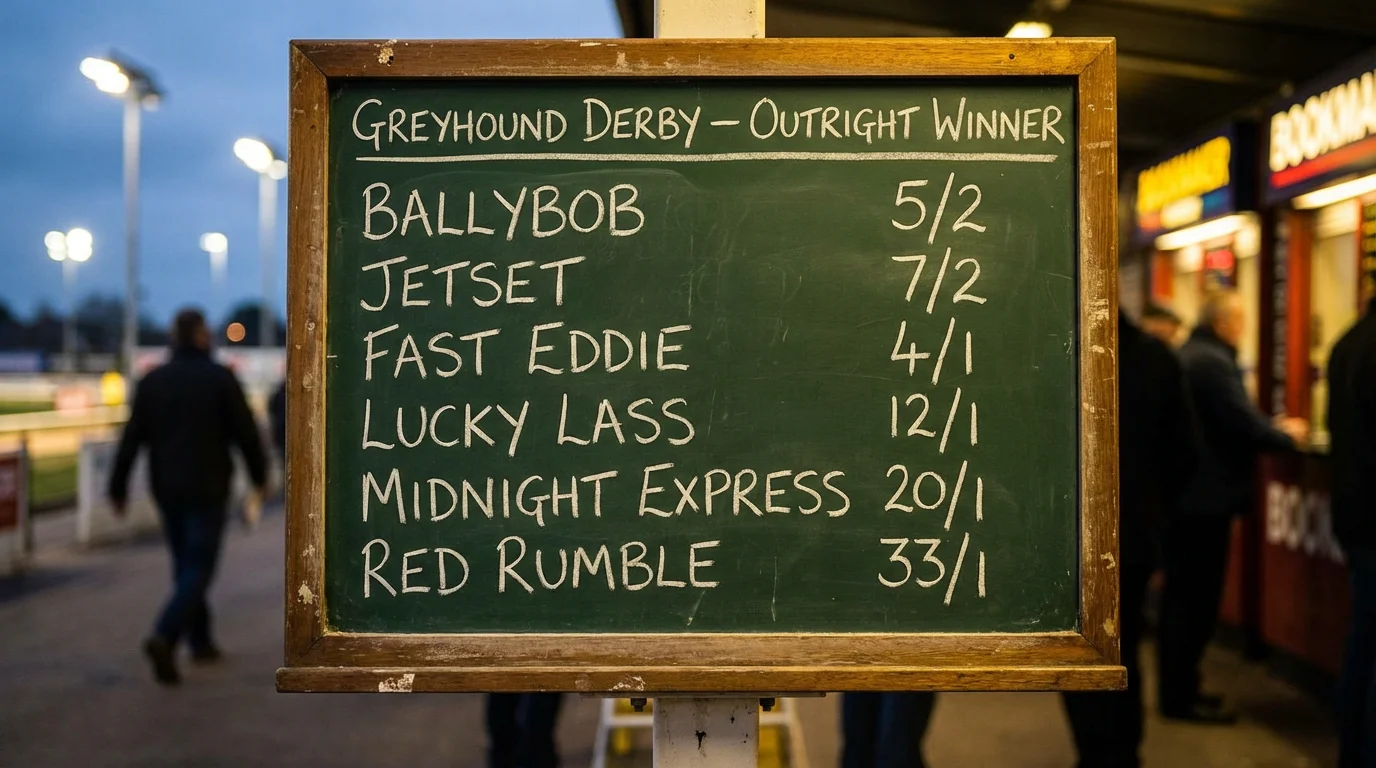
Before you place a penny on any runner, understand what you are betting into. The Greyhound Derby is not a race — it is a tournament. The distinction matters because every bet you place exists within a structure that eliminates dogs round by round, reshuffles trap draws, and produces form data that accumulates in value as the weeks progress. Misunderstand the format and you will misjudge the market at every stage.
The Derby operates as a knockout competition run over six rounds at Towcester, typically spanning from late April or May through to a Saturday evening final in June. 192 greyhounds are entered by trainers from across the United Kingdom and Ireland, making it the most internationally contested domestic greyhound event. Irish-trained dogs have dominated recent editions — a pattern that any serious bettor must factor into their analysis.
The competition structure creates a distinctive betting rhythm. Early rounds feature large fields of unknown quantities, producing longer odds and more volatility. Later rounds offer smaller pools of proven Towcester performers, tighter markets, and sharper pricing. Learning to match your betting approach to each stage is the foundational skill of Derby wagering.
The format sets the rules. The rounds set the rhythm. And the track itself sets the terms.
Round-by-Round Structure
The Derby begins with first-round heats, typically scheduled across two or three evenings in late April or May. The 192 entries are split into heats of six dogs each — roughly 32 heats in total. From each heat, the first three finishers qualify for the next round. This means approximately half the field is eliminated after a single race, often before many punters have even begun paying attention.
The second round reduces the field further, again taking the first three home from each heat. By the quarter-final stage, the competition has narrowed to around 24 dogs running in four heats of six, with the first three from each progressing. The semi-finals feature two heats of six, and only the first three from each semi earn a place in the final.
The final itself is a single six-dog race — the culmination of six weeks of knockout racing. The timeline usually runs from late April or mid-May to early or mid-June, with rounds spaced roughly a week apart. For the 2026 Derby, the first-round heats begin on 30 April, with the final on 6 June. Exact dates are confirmed by the GBGB and Towcester closer to the event.
This progressive elimination is what makes Derby betting fundamentally different from standard race-night wagering. A dog that wins its first-round heat does not simply cash a ticket — it provides a new data point for the ante-post market, alters the composition of subsequent rounds, and changes the probability landscape for every remaining competitor.
Towcester: The Track That Shapes the Derby
Towcester Greyhound Stadium is not a neutral venue. Its configuration actively influences outcomes, and bettors who ignore its characteristics are giving away an edge. The track runs over 500 metres with four bends on a sand surface, and it plays differently from the tighter urban circuits like Romford or Hove that many dogs run at during the rest of the year.
The bends at Towcester are wide and sweeping compared to most GBGB tracks. This has two significant consequences for betting. First, it reduces the advantage of inside trap draws relative to tighter venues — dogs drawn wide can negotiate the bends without losing as much ground. Second, it rewards dogs with sustained pace over those that rely purely on a fast break. A dog that leads into the first bend at Romford can often hold that lead through sheer geometry. At Towcester, the galloping nature of the track gives strong-finishing dogs a genuine chance to make up ground on the back straight.
The sand surface is also a factor. Going conditions at Towcester fluctuate with the weather, and the track can run fast or slow depending on recent rainfall and temperature. Going adjustments are published before each meeting, and the best Derby punters compare adjusted times across rounds rather than raw finishing times. A dog running 28.80 on fast going is not necessarily quicker than one clocking 29.10 on slow going — the calculated time tells the real story.
Course experience matters more at Towcester than at most tracks because the layout is atypical. Dogs that have raced there before the Derby — in open races, graded events, or trials — carry a quantifiable advantage. Trainers who regularly campaign at Towcester understand the track's rhythms and can prepare their dogs accordingly. This is one reason why track-specific form data is more predictive than general form for Derby selections.
Greyhound Derby Betting Markets
The Derby is not a single race — it is a six-week betting event, and each stage opens different market angles. Unlike a standard evening card where your options are limited to the next race in front of you, the Derby generates an evolving set of markets that change in character as the tournament progresses. Knowing which market to use at which stage is as important as knowing which dog to back.
The broadest distinction is between ante-post betting and race-day betting. Ante-post markets open weeks or even months before the first heat, offering outright winner odds on any dog in the entry list. Race-day markets cover individual heats and rounds as they happen — win, each-way, forecast, tricast. Between these two categories sits the heat-by-heat accumulator market, where you combine selections across multiple races on a single card.
In-play betting is available on Derby races through most major UK bookmakers, though the nature of greyhound racing — races last under 30 seconds — means in-play markets are extremely fast-moving and suit experienced bettors comfortable with split-second decision-making. For most punters, the value in Derby betting lies in the pre-race and ante-post markets where analysis time is on your side.
Ante-post betting
Available weeks or months before the Derby begins. Longer odds reflect uncertainty. No runner/no bet rules may apply. Best for punters who study entries and identify value early. Prices compress as rounds progress — early bets capture the widest margins.
Race-day betting
Available from the morning of each round. Tighter odds based on known form. Full range of bet types: win, each-way, forecast, tricast. Best for punters who prefer to assess dogs after watching them run at Towcester. Prices sharpen as more data becomes available.
Outright and Each-Way Markets
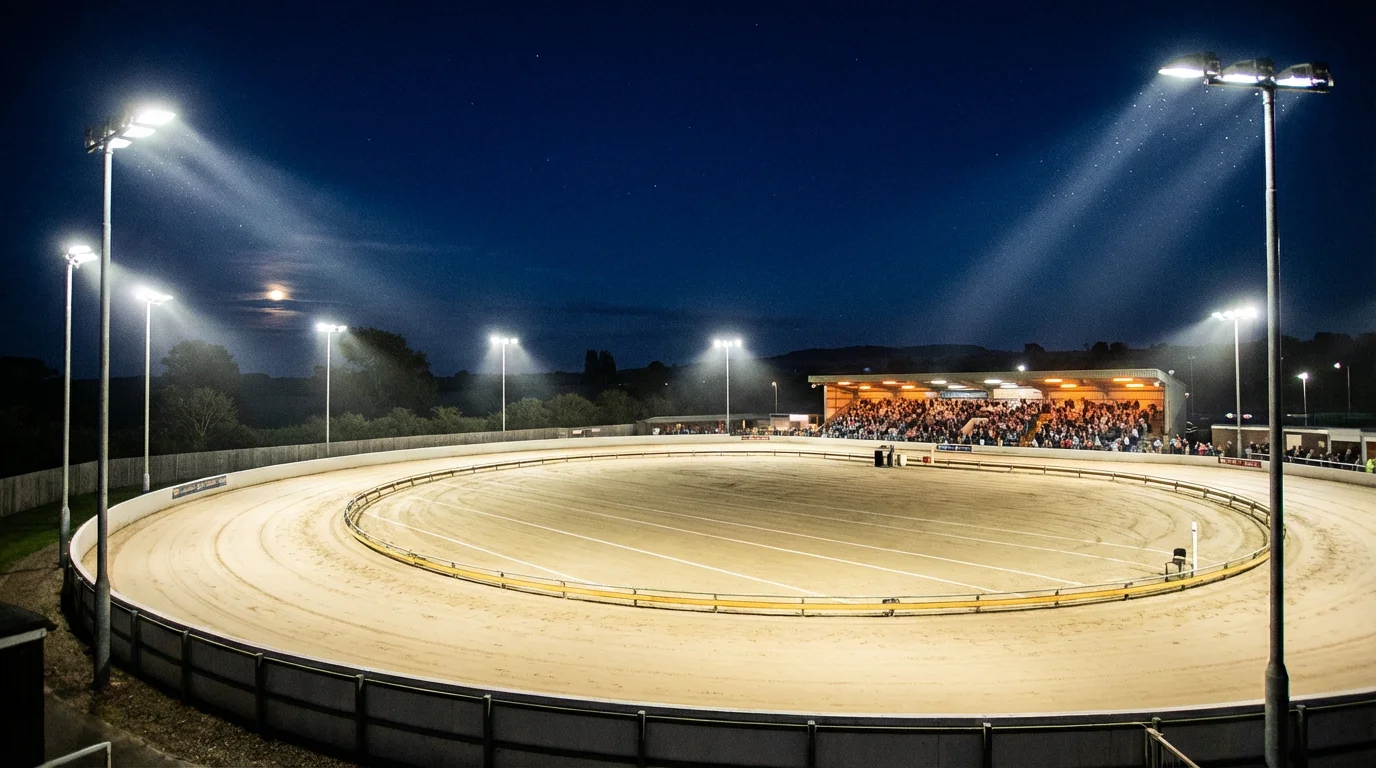
The outright winner market is the headline market for the Derby. Bookmakers price every dog in the entry list to win the final outright, and these odds shift continuously as the tournament unfolds. Early prices can range from single figures for the pre-tournament favourite to 100/1 and beyond for unproven entries. By the semi-final stage, the outright market typically features just 12 dogs at prices ranging from around 2/1 to 16/1.
Each-way betting on the outright market operates on standard place terms: typically one-quarter the odds for finishing in the first two at the final, though some bookmakers offer enhanced place terms — up to six places — on the ante-post outright market. This enhanced place coverage is where each-way bets on outsiders become genuinely interesting. A dog at 33/1 each way with six-place terms pays out if it simply reaches the final, regardless of where it finishes. For punters confident a dog can survive the knockout rounds, the each-way component can be more valuable than the win element.
Individual heat betting also supports each-way, though the standard greyhound terms apply: first and second in a six-runner field, at one-quarter the win odds. Each-way on heats is most useful when you rate a dog to run well but cannot separate it from the favourite with confidence.
Forecast and Tricast Bets
Forecast and tricast bets come into their own in Derby heats. With only six dogs per race, the permutation count is manageable — 30 possible exact-order pairs for a straight forecast, 120 possible exact-order trios for a straight tricast. Compare that with a 12-runner horse race, where the numbers balloon into the hundreds, and you can see why greyhound racing is the natural home for exotic bets.
A straight forecast requires you to predict the first two finishers in exact order. A reverse forecast covers both orderings, doubling your stake. A combination forecast lets you select three or more dogs and covers every possible first-and-second pairing — three selections generate six bets, four selections generate twelve. The computer straight forecast dividend is calculated after the race based on the starting prices of the first two home, and returns can be substantial. Typical Derby heat CSF dividends range from under 10 pounds to well over 100 pounds for a one-pound unit.
Tricasts follow the same logic extended to the first three finishers. A straight tricast names the exact 1-2-3 order. A combination tricast with three selections covers all six permutations; with four selections, it covers 24 permutations. In a six-dog field, the combination tricast is a realistic proposition — and in competitive Derby heats where the first three qualify, your tricast interest aligns neatly with the dogs most likely to progress.
Ante-Post Betting: Where the Value Lies
By the time the market has made up its mind, the value has already gone. That sentence should be tattooed on the inside of every Derby punter's eyelid. The ante-post market is where the widest price discrepancies exist, where information advantages are most exploitable, and where patient bettors build positions that pay off weeks later.
Ante-post odds on the Derby typically open several months before the first heat. At this stage, prices are long across the board — trainers have not yet confirmed their entries, trial form is incomplete, and bookmakers are pricing based on kennel reputation, breeding profiles, and speculative intelligence. A dog that opens at 50/1 in March and reaches the final might be trading at 5/1 or shorter on the night. The ante-post bettor who identified the dog early has captured value that the race-day bettor simply cannot access.
The key question is timing. Betting too early means committing capital with minimal information. Betting too late means paying for information the market has already absorbed. The sweet spot for many experienced Derby bettors is the period between entry confirmation and first-round heats — when you know which dogs are definitely running, you can assess trial form from Towcester, and the market has not yet been reshaped by actual competitive results.
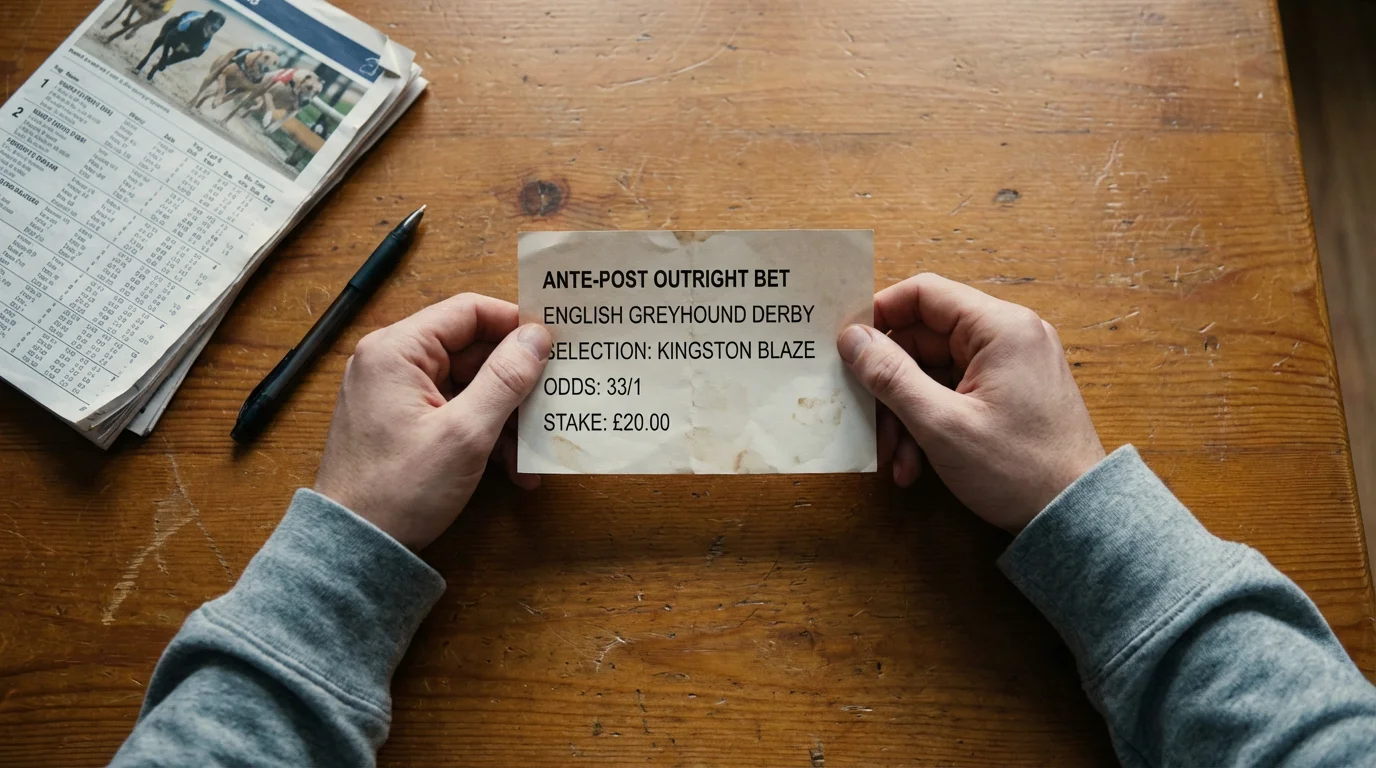
One critical consideration is the no runner/no bet rule. Many bookmakers now offer this protection on ante-post Derby bets, meaning your stake is refunded if your selection does not start in the competition. Check the terms before placing any ante-post bet — some operators only offer no runner/no bet on bets placed within a specific timeframe, while others apply it universally. Without this protection, an injury or withdrawal means a total loss of stake with no race having taken place.
The compression of prices through the tournament is where ante-post bets generate their returns. Consider a dog that opens at 33/1 in the outright market. After winning its first-round heat impressively, the price might shorten to 16/1. A strong quarter-final run could bring it to 8/1. By the semi-finals, the market might price it at 5/1. If it reaches the final, it could be as short as 3/1. The ante-post bettor still holds a 33/1 ticket. That differential is the structural advantage of early engagement.
Ante-post value scenario
Pre-Derby entry stage: Dog X is priced at 33/1 outright. You back it each way at 33/1 with six-place terms (1/4 odds, places 1-6).
Win element: 1 pound at 33/1 = 34 pounds return if Dog X wins the final.
Place element: 1 pound at 33/4 (8.25/1) = 9.25 pounds return if Dog X reaches the final in any position.
Total stake: 2 pounds. If Dog X reaches the final and finishes anywhere in the first six, the place element alone returns 9.25 pounds — a profit of 7.25 pounds before the win element is even considered.
By the semi-final stage, Dog X's outright price has shortened to 5/1. The race-day each-way bettor now gets 5/1 win and 5/4 place. The ante-post position is already six times more valuable.
Reading Derby Form: What Matters Most
A fast clock is only half the picture. In a six-round elimination, survival matters more than brilliance. The Derby is won not by the dog with the single fastest time in the competition but by the dog that runs consistently well across six rounds — different traps, different rivals, different going conditions — and arrives at the final with the fitness, confidence, and tactical adaptability to handle one more race under pressure.
Form reading for the Derby requires a shift in emphasis compared to standard graded racing. On a Tuesday night at Monmore, you are looking for the fastest dog in an isolated six-runner race. In the Derby, you are looking for the dog most likely to run in the first three across multiple rounds. That distinction changes which form factors you prioritise. Consistency becomes more valuable than peak speed. Versatility from different trap draws becomes more valuable than a perfect record from one position. Course form at Towcester becomes more valuable than general form at other tracks.
The most productive approach is to build a profile for each serious contender across four dimensions: recent times over 500 metres, grade and class progression, running style and early pace, and trainer credentials. Dogs that score well across all four dimensions are the ones that tend to progress deepest into the tournament — even if their headline speed figure is not the fastest in the field.
Backing the outright favourite in every Greyhound Derby final since 1985 would have produced a cumulative loss of approximately 11.46 pounds for every pound staked — a striking reminder that the market's top pick is rarely the value play.
Interpreting Times and Track Ratings
Raw finishing times at Towcester are meaningless without context. The track runs at different speeds depending on conditions: a going figure is published before each meeting, expressed as a positive number for slow going, negative for fast, and N for normal. A dog clocking 29.00 on slow going (+15) has effectively run faster than one recording 28.85 on fast going (-10), once adjustments are applied. Calculated time — CalcTm — normalises this, and it is the single most useful figure for comparing dogs across different rounds.
For Derby betting, the key is to compare calculated times across rounds rather than across tracks. A dog's time at Romford over 400 metres tells you relatively little about its 500-metre performance at Towcester. Focus on Towcester-specific data: trial times, open-race form at the venue, and times recorded during the Derby itself. By the quarter-final stage, you will have at least two rounds of Towcester data for every surviving dog — that data is gold.
Sectional times add another layer. The split time to the first bend indicates early pace and predicts first-bend position, which is a significant factor at Towcester despite its wide bends. Dogs that consistently break well and reach the first bend in the first two positions have a measurable advantage in the data. But at Towcester, unlike tighter tracks, a dog with strong finishing pace can recover from a slow start — so sectional data should inform your assessment, not dictate it.
A competitive Derby time at Towcester in 2026, accounting for standard going conditions, sits around 28.60 to 28.80 seconds on calculated time for the 500-metre trip. Dogs consistently posting below 28.70 through the rounds are operating at a level that can win the final. Dogs running 29.00 or slower on adjusted times are typically struggling against the standard required at this stage.
Trainer Records Worth Knowing
Trainer form in the Derby is not a peripheral statistic — it is a core selection factor. The competition has historically been dominated by a small number of elite kennels, and betting against trainers with proven Derby pedigree requires a strong contrarian case.
Charlie Lister OBE holds the record with seven Derby wins, a remarkable concentration of success that reflects decades of experience in preparing dogs for knockout competition at the highest level. Lister's record includes multiple winners across different eras and venues, suggesting a systematic approach to Derby preparation rather than a streak of luck.
In recent years, Irish trainers have increasingly dominated the English Derby. Graham Holland, Paul Hennessy, and Liam Dowling have all claimed the trophy, and Irish-trained dogs won three consecutive finals from 2022 to 2024. This cross-border dominance is driven partly by the depth of the Irish racing scene, which produces a high volume of quality dogs campaigned specifically for the English Derby as their primary target. Dowling's De Lahdedah took the 2024 title, while Patrick Janssens' Droopys Plunge broke the Irish stranglehold in 2025.
For bettors, trainer records serve two purposes. First, they identify dogs more likely to handle the pressures of tournament-style attrition — trainers with Derby experience know how to manage fitness across six rounds, when to trial and when to rest, and how to prepare a dog specifically for Towcester's layout. Second, trainer trends signal where the ante-post market might underestimate a runner. An unfashionable kennel entering its best dog in the Derby is easy for the market to overlook. A top Irish kennel entering three dogs guarantees at least one will attract disproportionate attention — and the other two might offer better value.
Trap Draw: The Numbers Behind the Colours
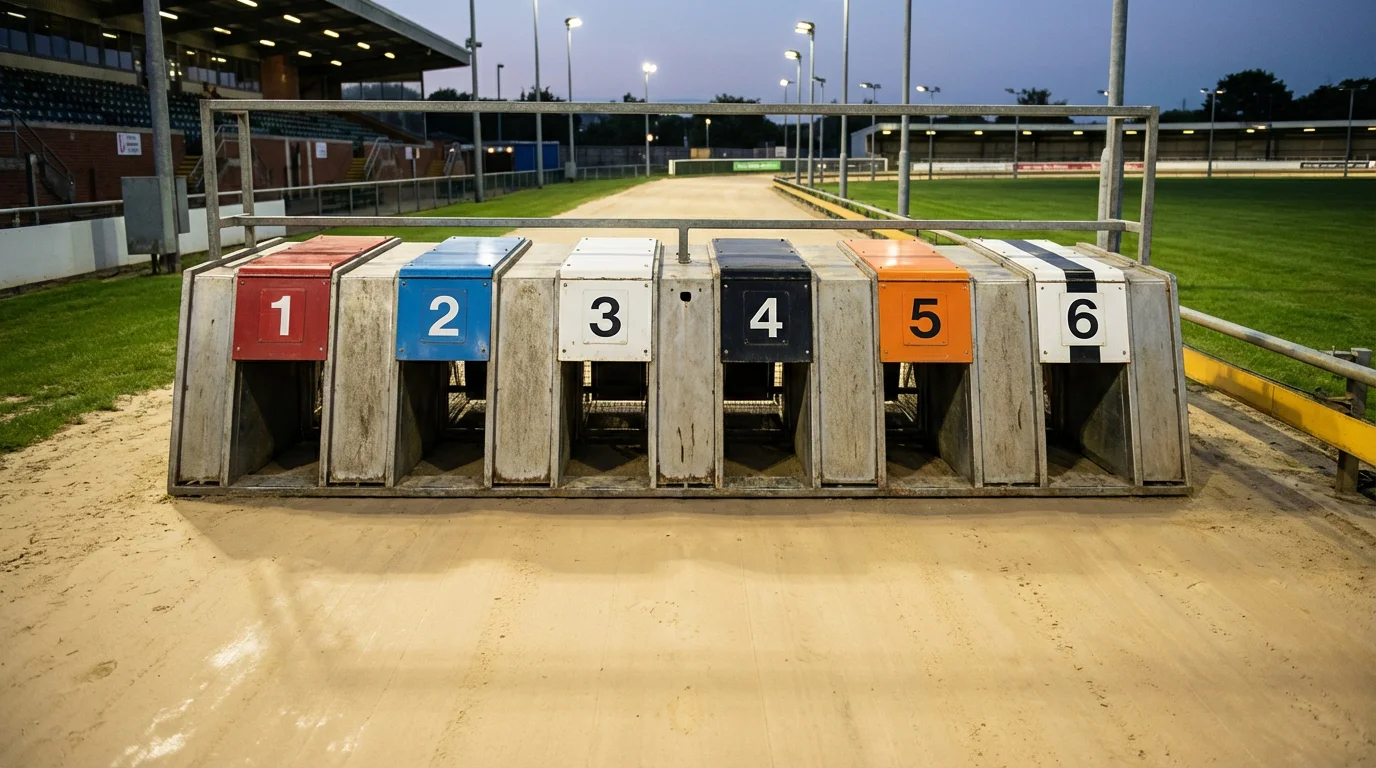
Trap bias is real, but it is not destiny. The trap draw — the box number and colour assigned to each dog — has a measurable influence on outcomes in greyhound racing, and the Derby is no exception. But the relationship between trap number and winning chance is more nuanced than many punters assume, and the data from Towcester tells a different story from the data at tighter tracks.
At venues like Romford, where the run to the first bend is short and the bends are tight, inside traps hold a pronounced statistical advantage. Trap 1 at Romford wins around 20-22% of races, well above the expected 16.7% average for six-trap racing. At Towcester, the advantage is smaller. The wider bends and longer run-in reduce the geometric benefit of an inside draw, and the track's galloping nature gives dogs in wider traps more room to find their line without losing significant ground.
Derby final statistics add another dimension. Historical data from finals at previous venues, particularly Wimbledon, showed a notable drought for trap 5 — no winner from that box between 2009 and the track's closure. Trap 1 also underperformed in finals compared to heats, which some analysts attributed to the pressure of the occasion affecting box behaviour (a dog that senses crowd noise and tension may break less cleanly from the inside position). At Towcester, the sample size of finals is still building, and the data does not yet show the same patterns with statistical confidence.
The practical lesson is this: factor the draw into your assessment, but do not let it override form. A dog with proven early pace and a strong Towcester record drawn in trap 4 is not automatically a weaker proposition than a less consistent runner drawn in trap 1. The draw matters most when separating dogs of similar ability — it is a tiebreaker, not a verdict.
Where draw analysis becomes most valuable is in forecast and tricast betting. If you can identify which dogs have the early pace to handle their draw and which are likely to be disadvantaged, you can construct more accurate first-two and first-three predictions. This is where granular trap data — not just win percentages but sectional times from specific boxes — earns its keep.
DO
- Check trap draw history at Towcester specifically — not aggregate data from other tracks.
- Factor the draw into each-way and forecast calculations where it can tilt marginal decisions.
- Compare trap records across different rounds of the Derby — heats and finals produce different patterns.
DON'T
- Dismiss a dog solely because of its trap draw — form and ability matter more than box number.
- Assume Wimbledon-era trap data applies directly to Towcester — the tracks are fundamentally different.
- Overweight draw in open-class form where dogs may have encountered random draws throughout their careers.
Practical Betting Strategies for the Derby
Forget the fancy theories. Here is what actually works when real money is on the line. Derby betting strategies are not academic exercises — they are frameworks for deploying capital across a six-week event where the information landscape changes every seven days. The punters who consistently profit from the Derby are not the ones with the most sophisticated models. They are the ones with the clearest process and the discipline to follow it when the market gets noisy.
The most effective overall approach treats the Derby as a campaign rather than a single betting event. This means allocating a specific bankroll to Derby betting and dividing it across stages: a portion for ante-post positions taken before the first round, a portion for heat-by-heat betting during the tournament, and a reserve for the semi-finals and final where the information is richest and the edges are sharpest.
A sensible split for a dedicated Derby bank might be 30% on ante-post selections before first-round heats, 40% distributed across heat betting from rounds one through the quarter-finals, and 30% reserved for semi-finals and the final. This structure prevents the common mistake of spending the entire bankroll on ante-post positions — leaving nothing to exploit the value that emerges once competitive form data is available.
Derby favourites: proceed with caution
In the last 16 Greyhound Derby finals, the outright favourite has won just twice. The elimination format, random trap draws in open-race finals, and the physical toll of six rounds combine to make the Derby one of the most unpredictable major events in any betting sport. Always assess independently rather than following the market default.
Finding Value Bets Round by Round
Value in Derby betting is not static — it migrates from one part of the market to another as the tournament progresses. In the ante-post phase, value hides in dogs whose ability the market has not yet priced. In the early rounds, value appears when first-round heat results reveal dogs running better than their pre-tournament odds suggested. In the later rounds, value emerges when the market overreacts to a single impressive performance or overlooks a dog that qualified comfortably without a flashy time.
The methodology for identifying value is consistent even as the context changes. Start with speed figures: compare each dog's calculated time at Towcester against the field average for that round. Dogs running two or more lengths faster than the round average on adjusted time are performing at a level that should command shorter odds. If the market is still pricing them as mid-range contenders, you have found a potential value bet.
Next, look at the draw. A dog that produced a strong time from an unfavourable draw in the previous round has likely underperformed its true ability. If it draws a better box in the next round, the market may not fully account for the improvement that a cleaner run can deliver. Conversely, a dog whose fast time came from a perfect inside draw against moderate opponents may be overrated heading into a tougher assignment.
Running style matters too. At Towcester, dogs with the pace to sit second or third through the early bends and then finish strongly have a structural advantage in knockout racing. They avoid the scrimmaging at the first bend that can derail front-runners drawn wide, and they are less dependent on a perfect break. Identifying these closers in a field dominated by early-pace dogs is one of the most reliable value angles in Derby betting.
Hedging and Trading Your Derby Positions
One of the underappreciated advantages of Derby betting is the ability to trade your positions as the tournament unfolds. If you have backed a dog ante-post at 20/1 and it progresses to the semi-finals where the market now prices it at 4/1, you have the option to lay the dog on a betting exchange — effectively locking in a profit regardless of the final result.
The mechanics are straightforward. Suppose you backed Dog A at 20/1 for 10 pounds (potential return: 210 pounds). Dog A reaches the semi-finals and the exchange price is 5.0 (equivalent to 4/1). You lay Dog A at 5.0 for 40 pounds. If Dog A wins, you collect 210 from your ante-post bet and pay out 160 on the lay (40 x 4.0 liability) — net profit 50 pounds plus your original stake. If Dog A loses, you lose your 10-pound ante-post stake but collect 40 pounds from the lay — net profit 30 pounds. Either way, you are guaranteed a positive outcome.
Not every position needs to be traded. If you believe your ante-post selection remains the best dog in the competition and the current price understates its chance, holding the full position may be the correct decision. Trading makes sense when the price compression has delivered a substantial paper profit and you want to de-risk — or when new information (an injury concern, a bad draw for the final, deteriorating form) has weakened your original thesis.
For bettors without exchange accounts, the alternative is to back against your selection with a traditional bookmaker — though this is less precise and usually involves accepting a lower guaranteed return due to the bookmaker's margin. Exchange trading is the cleaner tool for this purpose, and anyone serious about Derby betting should have an active exchange account alongside their standard bookmaker accounts.
What Past Winners Tell Us About the Next One
History does not repeat in greyhound racing, but it does leave footprints on the sand. Studying past Derby winners reveals patterns that are not guaranteed to persist but that have held strongly enough across decades to inform forward-looking analysis.
The most striking trend of the modern era is Irish dominance. Three of the last five Derby winners were trained in Ireland, continuing a pattern that accelerated when the event moved to Towcester. Irish kennels — particularly those based in Limerick, Tipperary, and Kilkenny — produce a disproportionate share of elite greyhounds, and the best Irish trainers target the English Derby as the peak of their annual campaign. For bettors, this means giving serious attention to Irish entries in the ante-post market, even when they are unfamiliar names. The training infrastructure that produced De Lahdedah, Priceless Blake, and their predecessors continues to feed dogs into the 2026 competition.
In terms of winner profiles, Derby champions tend to share several characteristics. Most are aged between two and three and a half years — old enough to have proven their ability in open-class racing but young enough to be improving or at peak performance. Winners are typically strong middle-distance dogs with the pace to sit handy in the early stages and the stamina to sustain their run over 500 metres. Pure front-runners can win the Derby, but the data suggests that dogs with tactical flexibility — the ability to lead or sit second — have a higher success rate across multiple rounds.
Winning margins in Derby finals are often narrow. The last five finals have been decided by two lengths or fewer, which underlines the competitive nature of the event and the importance of marginal factors — trap draw, break, and first-bend position — in deciding the outcome. For bettors, this means that small edges in form reading and draw analysis can have an outsized impact on profitability. The dog that wins the Derby is rarely the only dog that could have won it.
Round-by-round improvement is another signal worth tracking. Dogs that run progressively faster calculated times as the Derby advances — rather than peaking in the early rounds — tend to be the ones that arrive at the final in the best form. This pattern of building through the tournament is something the ante-post market often undervalues, because early-round results attract more attention than the trajectory of improvement.
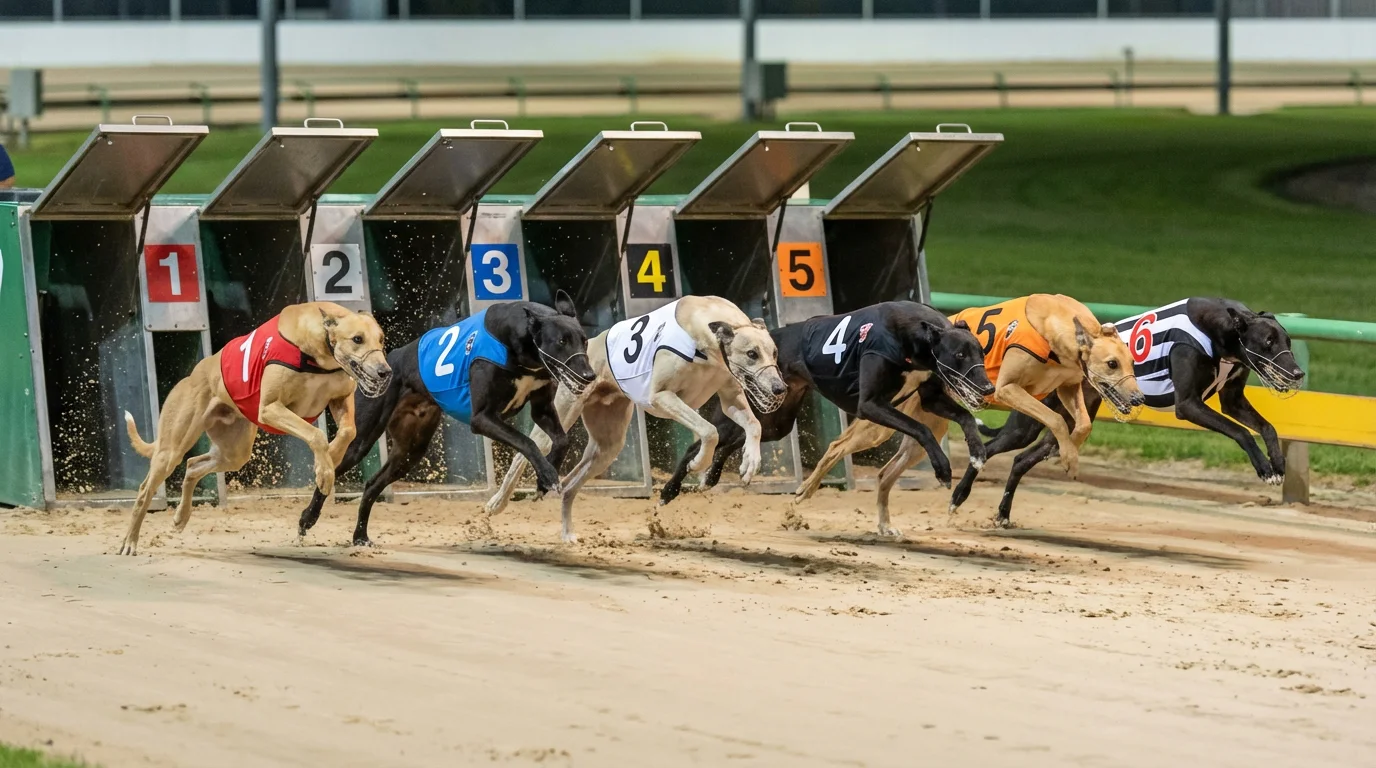
Derby winners share two traits: round-by-round consistency and the tactical speed to handle Towcester's bends. Find the dog that combines both and you have found the profile that wins finals.
Greyhound Derby Betting: Key Questions Answered
What are the most popular Greyhound Derby betting markets?
The most widely used Derby betting markets are the outright winner market (ante-post and on the day of the final), each-way betting on the outright result with enhanced place terms, individual heat win and each-way markets, straight and combination forecasts on individual heats, tricasts on individual heats, and in-play betting during live races. The outright each-way market with six-place terms is particularly popular for ante-post betting because it pays out if the dog simply reaches the final. Forecast betting is the most popular exotic market for heat-by-heat wagering, with the six-dog field making combination forecasts an accessible option. In-play markets are available but move extremely quickly given that races last under 30 seconds. Most experienced Derby bettors combine ante-post outright positions with heat-by-heat forecasts as the tournament progresses.
Does trap draw actually matter in Greyhound Derby betting?
Trap draw matters in Derby betting, but less so at Towcester than at tighter tracks. Towcester's wide bends and long straights reduce the geometric advantage of inside draws, meaning that dogs drawn in traps 3, 4, and 5 are not as significantly disadvantaged as they would be at Romford or Hove. Historical data from Derby finals at previous venues showed a notable drought for trap 5 and underperformance from trap 1 in finals specifically, though the Towcester sample is still developing. The practical approach is to factor draw into your assessment as one variable among several — it matters most when separating dogs of similar ability and is most useful for constructing forecast and tricast bets. Avoid dismissing a strong dog purely on draw, and avoid backing a weaker dog purely because it drew the inside.
How does ante-post betting work for the Greyhound Derby?
Ante-post betting on the Greyhound Derby means placing a bet on the outright winner before the competition begins — sometimes weeks or months in advance. Odds are longer at this stage because the field is larger and less is known about each dog's form and fitness. Prices compress as the Derby progresses and dogs are eliminated. Many bookmakers offer no runner/no bet protection, which refunds your stake if your selection does not start in the competition. Without this rule, a withdrawal means a lost stake. The main advantage of ante-post betting is capturing value at prices that will shorten if the dog performs well. The main risk is committing capital before you have competitive Towcester form data. Most experienced punters place their ante-post bets after entries are confirmed but before first-round heats, balancing information quality against price availability. Each-way ante-post bets with enhanced place terms are popular because they pay out if the dog reaches the final regardless of finishing position.
The Last Bend: Why the Derby Stays Unmissable
The stands might be quieter now, but the betting ring has never been louder. The English Greyhound Derby occupies a peculiar position in British sport: it is simultaneously the biggest event in its discipline and a niche concern for the broader sporting public. Stadium attendances have declined from the tens of thousands that packed White City in the mid-twentieth century. But the betting handle on the Derby — the total volume of money wagered across bookmakers, exchanges, and pools — tells a different story. Online betting has replaced the trackside experience for most punters, and the Derby remains the event that draws casual greyhound bettors into the sport each summer.
What makes the Derby enduringly compelling from a betting perspective is the tension inherent in the knockout format. No other greyhound event demands this level of sustained engagement. A dog that dominates the first round can be eliminated by a bad break in the quarter-finals. An outsider that scrapes through its heat can improve round by round and arrive at the final as a genuine contender. The attrition creates narrative arcs that sustain interest over six weeks — and those narratives move markets in ways that create opportunity for the attentive bettor.
The unpredictability keeps bookmakers nervous too. The Derby is one of the few events in greyhound racing where the layers routinely take a position rather than simply balancing their book. When a heavily backed favourite is eliminated in the semi-finals, the ante-post liabilities do not simply disappear — they redistribute across the remaining runners. That redistribution creates sharp, often mispriced markets in the final days before the last race of the competition.
For the bettor willing to do the work — to study form across rounds, to compare times under different conditions, to track the draw, to price each market stage independently — the Derby offers something that most greyhound racing does not. It offers enough data, enough time, and enough market depth to build a genuine edge. Not a guaranteed profit, but an honest edge earned through the kind of analysis that daily BAGS racing rarely rewards at this scale.
The 2026 Derby will follow the same format, at the same track, with the same knockout brutality that has defined the event for nearly a century. The dogs will change. The trainers will change. The prices will change. What will not change is the fundamental equation: the punter who reads the card more carefully, prices the market more accurately, and manages their bankroll more patiently will be the one who walks away in profit when the last trap opens on final night.