
Understanding Greyhound Racing Odds Formats
Best Greyhound Betting Sites – Bet on Greyhounds in 2026
Loading...
The Language of Betting
Odds are the language of betting. If you don’t speak it fluently, you’re always at a disadvantage. Every bet you place on the Greyhound Derby — whether it’s an ante-post outright, a heat winner, a forecast, or an accumulator — is priced in odds. Those odds tell you two things: what the bookmaker will pay you if your bet wins, and what probability the market assigns to the outcome. Understanding both of those functions — the payout calculation and the implied probability — is fundamental to making informed betting decisions rather than hopeful ones.
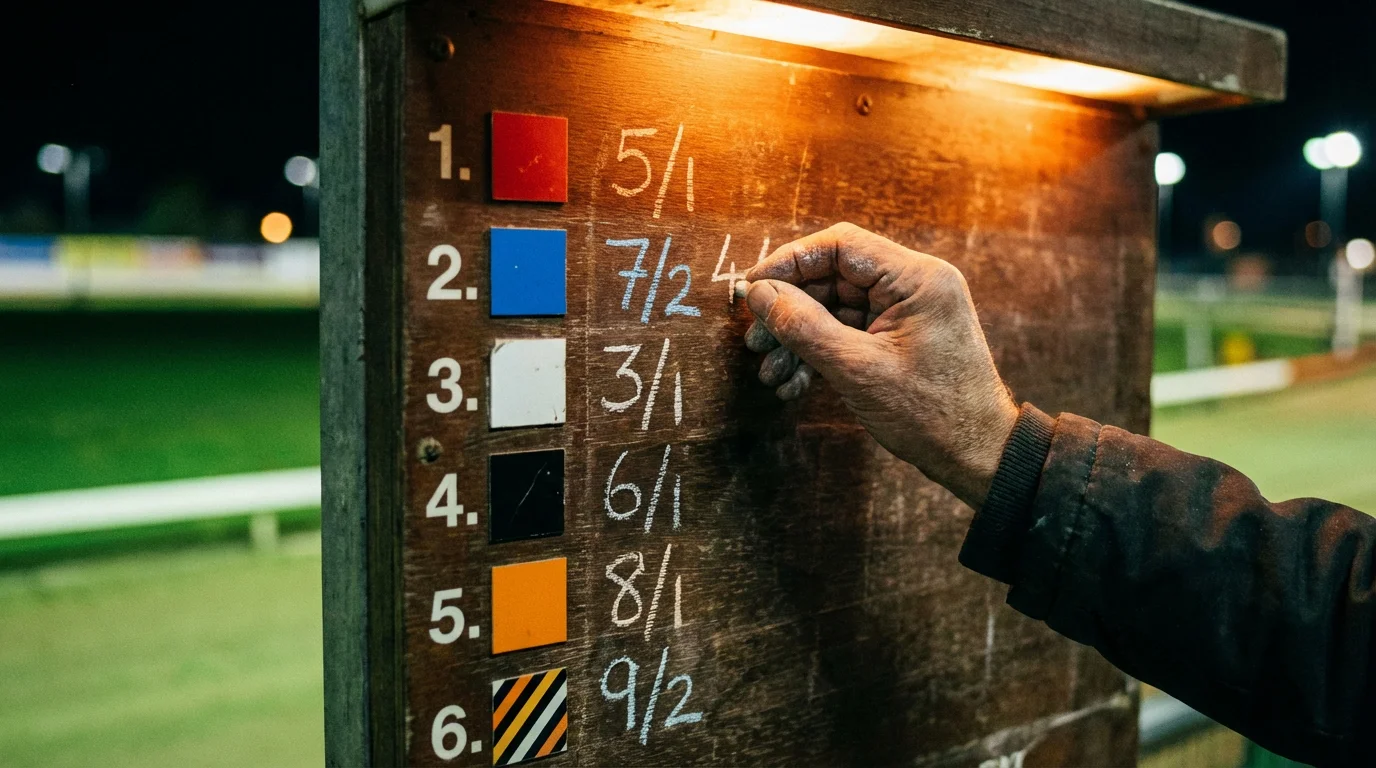
In the UK, greyhound racing odds are predominantly displayed in fractional format: 5/1, 7/2, 11/4. But online bookmakers also offer decimal and American formats, and many punters encounter all three at different times — fractional on the racecourse, decimal on a European exchange, American on an international sportsbook. Being able to read and convert between formats isn’t a specialist skill. It’s a basic requirement for any punter operating across platforms.
Fractional Odds: The UK Standard
Fractional odds are the traditional format used in British and Irish greyhound racing. They express your potential profit relative to your stake. When you see odds of 5/1 (spoken as “five to one”), it means that for every £1 you stake, you’ll receive £5 in profit if the bet wins, plus your original £1 stake returned. A £10 bet at 5/1 returns £60 in total: £50 profit plus your £10 stake.
The first number (the numerator) represents the profit. The second number (the denominator) represents the stake. At 7/2 (“seven to two”), you profit £7 for every £2 staked. A £10 bet at 7/2 returns £45: the ratio of 7/2 applied to £10 gives £35 profit, plus the £10 stake back. At 11/4 (“eleven to four”), a £4 stake produces £11 profit; a £10 bet returns £37.50 total.
Odds-on prices — where the first number is smaller than the second — indicate a strong favourite. At 4/6 (“four to six” or “six to four on”), you need to stake £6 to win £4 profit. A £10 bet at 4/6 returns £16.67 total. Odds-on prices are common in Derby heats where a clear favourite is expected to win, and they represent the market’s assessment that the outcome is more likely than not.
Even money (1/1, or “evens”) is the pivot point: stake £1, profit £1. Anything shorter than evens is odds-on. Anything longer is odds-against. In the Derby ante-post market, the favourite typically sits between 3/1 and 6/1 in the weeks before the first round, with the field stretching out to 33/1 or longer for unfancied entries.
One common source of confusion is prices like 100/30. This is simply a fractional representation that hasn’t been reduced to its simplest form — it’s equivalent to 10/3 (roughly 3.33/1). Bookmakers sometimes display these unreduced fractions, and they’re functionally identical to their simplified versions. If the arithmetic feels awkward, convert to decimal format for easier calculation.
Decimal and American Formats
Decimal odds express the total return per unit staked, including the stake itself. Where fractional odds of 5/1 tell you your profit is five times your stake, the decimal equivalent — 6.00 — tells you your total return is six times your stake. The conversion is straightforward: divide the numerator by the denominator and add 1. So 5/1 becomes (5 ÷ 1) + 1 = 6.00. And 7/2 becomes (7 ÷ 2) + 1 = 4.50. A £10 bet at 4.50 decimal returns £45, identical to 7/2 fractional.
Decimal odds are the standard format on betting exchanges like Betfair and are widely used across continental Europe and Australia. Their main advantage is mathematical simplicity. Calculating accumulator returns, for instance, is far easier in decimal: you simply multiply the decimal odds of each leg together. A treble at 3.00, 4.50, and 2.50 decimal pays 3.00 x 4.50 x 2.50 = 33.75 for every £1 staked. Performing the same calculation in fractional format (2/1, 7/2, 6/4) requires converting to decimals first or using a considerably more complex formula.
Odds-on prices are easier to read in decimal format too. Fractional odds of 4/6 become 1.67 in decimal — immediately clear that your total return is 1.67 times your stake. There’s no ambiguity about which number represents what.
American odds use a different system entirely, based around a $100 reference point. Positive American odds (e.g., +500) tell you how much profit you’d make on a $100 stake: +500 means $500 profit from $100 staked, equivalent to 5/1 fractional or 6.00 decimal. Negative American odds (e.g., -150) tell you how much you need to stake to make $100 profit: -150 means you stake $150 to win $100, equivalent to 2/3 fractional or 1.67 decimal.
American odds are rarely used in UK greyhound racing but appear on international sportsbooks and some betting comparison sites. The conversion formulas are: for positive American odds, divide by 100 and add 1 to get decimal (so +350 becomes 4.50 decimal); for negative American odds, divide 100 by the absolute value and add 1 (so -200 becomes 1.50 decimal). If these formulas feel unwieldy, most bookmaker apps include an odds format toggle that handles the conversion for you.
Implied Probability and Finding Value
Every set of odds contains an implied probability — the likelihood the market assigns to that outcome occurring. This is the most important concept in betting mathematics, and it’s the bridge between understanding odds as a payout mechanism and using them as a decision-making tool. If you can calculate the implied probability of a price and compare it to your own assessment of the actual probability, you can identify value — bets where the bookmaker’s price is more generous than the true chance of the outcome warrants.
The formula for implied probability from decimal odds is simple: 1 divided by the decimal odds, expressed as a percentage. At decimal odds of 4.00 (3/1 fractional), the implied probability is 1 ÷ 4.00 = 0.25, or 25%. The market is saying this outcome has a one-in-four chance of happening. At 6.00 (5/1), the implied probability is 16.7%. At 2.00 (evens), it’s 50%.
For fractional odds, the formula is: denominator divided by (numerator + denominator). At 3/1, the implied probability is 1 ÷ (3 + 1) = 25%. At 7/2, it’s 2 ÷ (7 + 2) = 22.2%. At 11/4, it’s 4 ÷ (11 + 4) = 26.7%.
The key insight for Derby bettors is this: if you believe a dog has a 30% chance of winning its heat, any price with an implied probability below 30% represents value. At 3/1 (implied 25%), the dog is overpriced relative to your assessment — that’s a value bet. At 2/1 (implied 33%), the dog is underpriced — the market thinks it’s more likely to win than you do, and the bet doesn’t offer value by your estimation.
There’s an important caveat. If you add up the implied probabilities of all six dogs in a race, the total will exceed 100% — typically landing between 115% and 125% for a standard greyhound race. The excess is the bookmaker’s margin (or overround), and it represents the built-in advantage the bookmaker holds. A market with a total implied probability of 118% means the bookmaker expects to retain roughly 18% of the money wagered over time. The tighter the overround, the fairer the market. Shopping between bookmakers for the best price on your selection effectively reduces the overround you’re paying on each bet.
Value identification isn’t about always being right. It’s about systematically finding bets where the price is in your favour over time. A 3/1 shot that wins 30% of the time will produce a profit in the long run, even though it loses 70% of the time. That’s the mathematical foundation of successful betting — and it starts with understanding exactly what the odds are telling you.