Towcester Greyhound Stadium: Track Guide for Derby Bettors
Best Greyhound Betting Sites – Bet on Greyhounds in 2026
Loading...
The Track the Derby Calls Home
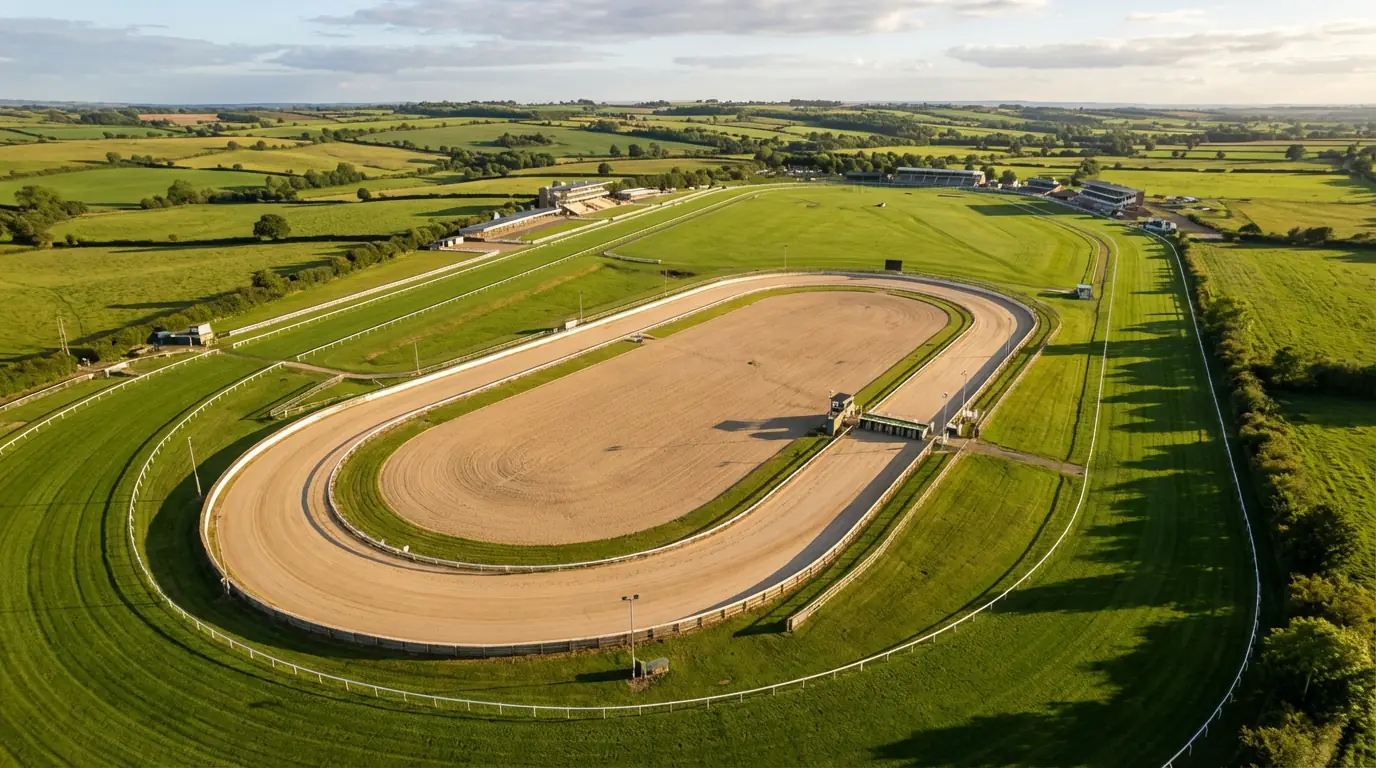
You can’t bet the Derby properly without understanding the track it’s run on. Since 2017, the English Greyhound Derby has been staged at Towcester Greyhound Stadium in Northamptonshire — a venue that broke the mould when it opened in December 2014 as the first new licensed greyhound track in Britain for nearly two decades. Built inside the existing Towcester horse racecourse at a cost of £1.5 million, the track represented a deliberate departure from the tight, inner-city circuits that had defined British greyhound racing for most of its history. Wider bends, a longer run to the first turn, and an all-sand surface gave Towcester a character distinct from anything that came before it.
For Derby bettors, that character matters. Every greyhound track produces its own patterns — trap biases, running-style preferences, surface behaviours — and Towcester is no exception. Dogs that excel at tighter circuits like Romford or Crayford don’t automatically transfer that form to Towcester. Conversely, dogs with stamina and a sweeping running style can find the layout perfectly suited to their strengths. Understanding the physical characteristics of the track is not academic trivia. It’s a direct input into your selections.
The Derby was held at Wimbledon from 1985 to 2016 and briefly at Nottingham in 2019 and 2020 when Towcester went into administration. It returned in 2021, and the venue now holds a long-term contract to stage the competition. For punters analysing Derby form, this means the Towcester-era data — from 2017 onwards, excluding the Nottingham years — is the most relevant dataset. Anything from Wimbledon or earlier provides historical colour but limited predictive value for the modern competition.
Layout, Dimensions and Surface
Towcester’s greyhound track has a circumference of 420 metres. It’s an oval configuration with four bends, but the design philosophy prioritised width over compactness. The bends are notably wider than at most British tracks — a deliberate choice intended to reduce crowding and interference, particularly in larger fields. The result is a track where dogs have more room to race, where wide runners aren’t automatically penalised by tight turns, and where the margins between inside and outside paths through the bends are smaller than at older, narrower circuits.
The Derby is run over 500 metres, one of the standard distances at the track. The start position places the traps on the back straight, giving dogs a run of approximately 80 metres to the first bend. That distance is significant. At tighter tracks with shorter runs to the first turn — Romford’s 400-metre trip, for instance — the inside trap holds a pronounced advantage because there’s less time for dogs to find their position before the bend arrives. Towcester’s longer run-up mitigates that inside-trap edge. Dogs in wider traps have time to stride out and establish position before the first turn, which helps explain why the middle traps tend to produce marginally better results than the extremes at this venue.
The surface is all-sand — a feature that distinguishes Towcester from the mixed surfaces found at some other tracks. Sand generally favours dogs with strong, balanced running actions over those that rely on grip and agility through tight turns. Sand is also more demanding physically than the harder surfaces used at some inner-city stadiums, which becomes relevant during the Derby’s six-week grind. Dogs racing weekly on sand may show fatigue more readily than they would on a firmer surface, and weight monitoring through the rounds becomes a useful indicator of how well a dog is coping with the physical demands.
The hare system is an outside Swaffham rail — the standard configuration for most modern British tracks. The hare speed is calibrated for the distance and tends to produce even-paced running, though track staff adjust the pace based on the quality of the field and the conditions on the night. For bettors, the hare’s influence is indirect: a consistent pace rewards dogs that settle into a rhythm, while erratic hare management can disrupt running patterns and produce unexpected results.
One physical characteristic that’s easy to overlook is the track’s position within the horse racecourse. The greyhound circuit sits inside the horse racing course, which means it’s more exposed to wind than enclosed urban stadiums. On breezy evenings, the back straight can catch a headwind that affects times and potentially favours dogs with the power to push through it rather than lighter, speed-based runners. This isn’t something the racecard shows you, but it’s something experienced Towcester watchers factor into their assessments.
Weather, Conditions and the Changing Surface
Sand doesn’t react like turf. That distinction underpins everything about how weather affects racing at Towcester. On dry, warm evenings the sand firms up and produces faster times. Running times in the low-28-second range almost always coincide with dry conditions, because the firmer surface returns energy more efficiently and the dogs’ paws dig in less. Front-runners tend to benefit from fast going, as the surface lets them maintain their pace through the bends without the deceleration that a looser, wetter surface might cause.
Rain changes the equation. Wet sand becomes heavier and more energy-sapping. Times slow, often by two to four tenths of a second compared to a dry evening. Dogs with stamina and power — the types that grind out their running rather than rely on explosive speed — tend to handle wet conditions better. Closers and middle-run dogs can benefit too, because the heavier surface saps the energy of front-runners through the third and fourth bends, opening up the race in the closing stages. If rain is forecast for a Derby round night, adjusting your selections to account for the surface change is not overcautious — it’s basic preparation.
Towcester’s drainage is well-engineered — 60,000 tonnes of soil were laid during construction to bring the track to the correct level — and the surface generally recovers well between races. However, across an evening’s card the going can shift. The first race may run on firm sand, but by the tenth or eleventh race the repeated traffic and the maintenance between races — harrowing and watering — can loosen the surface and slow the times marginally. Derby heats are typically positioned in the middle to late portion of the card, which means they’re often run on a surface that’s been raced on several times already. Comparing times from the early and late portions of the same card can reveal whether the going has changed enough to matter.
Temperature also plays a role, though it’s subtler. On hot summer evenings — the Derby runs from May through June — the sand can dry out rapidly, creating a fast but potentially uneven surface if parts of the track dry faster than others. Cooler, overcast evenings tend to produce more consistent conditions. None of these factors are individually decisive, but in a competition where margins are measured in tenths of a second, the cumulative effect of conditions on times and running styles is worth tracking.
Knowing Towcester, Knowing the Derby
The track and the competition are inseparable now. To assess a dog’s Derby chances is to assess its suitability for Towcester — its ability to handle the wide bends, the sand surface, the 500-metre trip, the demands of racing weekly on a physically taxing circuit. Some dogs arrive with brilliant form from other venues and struggle to translate it here. Others have modest records elsewhere but find Towcester’s layout perfectly suited to their action and immediately improve.
Watch for trial times. Before the Derby, most serious contenders are trialled at Towcester to familiarise them with the track and to give trainers and punters a benchmark. A dog that trials fast here — even if its recent race form at other tracks has been unremarkable — deserves more attention in the ante-post market than its headline numbers suggest. The inverse applies too: a dog with brilliant form at Romford or Sheffield that trials slowly at Towcester may be less suited to the track than its price implies.
The punters who consistently find Derby value are the ones who think in terms of track fit rather than raw form. Towcester tells you what it rewards and what it punishes. Learn its language, and the Derby becomes considerably more readable.