How to Read a Greyhound Racecard
Best Greyhound Betting Sites – Bet on Greyhounds in 2026
Loading...
The Punter’s Toolkit in One Glance
A racecard is a compressed biography. Read it right and it tells you everything you need. Every greyhound entered in every race at every licensed track in Britain has its essential data printed on a racecard — name, trap, trainer, form figures, times, weight, grade, and breeding. For the casual observer, it looks like an impenetrable grid of numbers and abbreviations. For the informed punter, it’s the single most important document in greyhound betting. The Derby racecard, in particular, concentrates the information that drives a multi-week, multi-round competition into a few compact lines per dog.
Learning to read a racecard properly is not a luxury skill reserved for serious gamblers. It’s the baseline requirement for making any informed bet. Without understanding what each element means — and more importantly, how different elements interact — you’re essentially placing money based on names and trap colours. That works occasionally. It doesn’t work consistently. The racecard gives you the raw materials to construct an informed opinion, and in a competition as well-documented as the English Greyhound Derby, those raw materials are rich enough to build a genuine analytical edge.
The format varies slightly between different media — the Racing Post card looks different from a track programme, which looks different from the card displayed on a bookmaker’s website or app. But the core data fields are universal. Once you know what you’re looking at, the format becomes irrelevant. The information speaks for itself.
Every Element on the Card, Explained
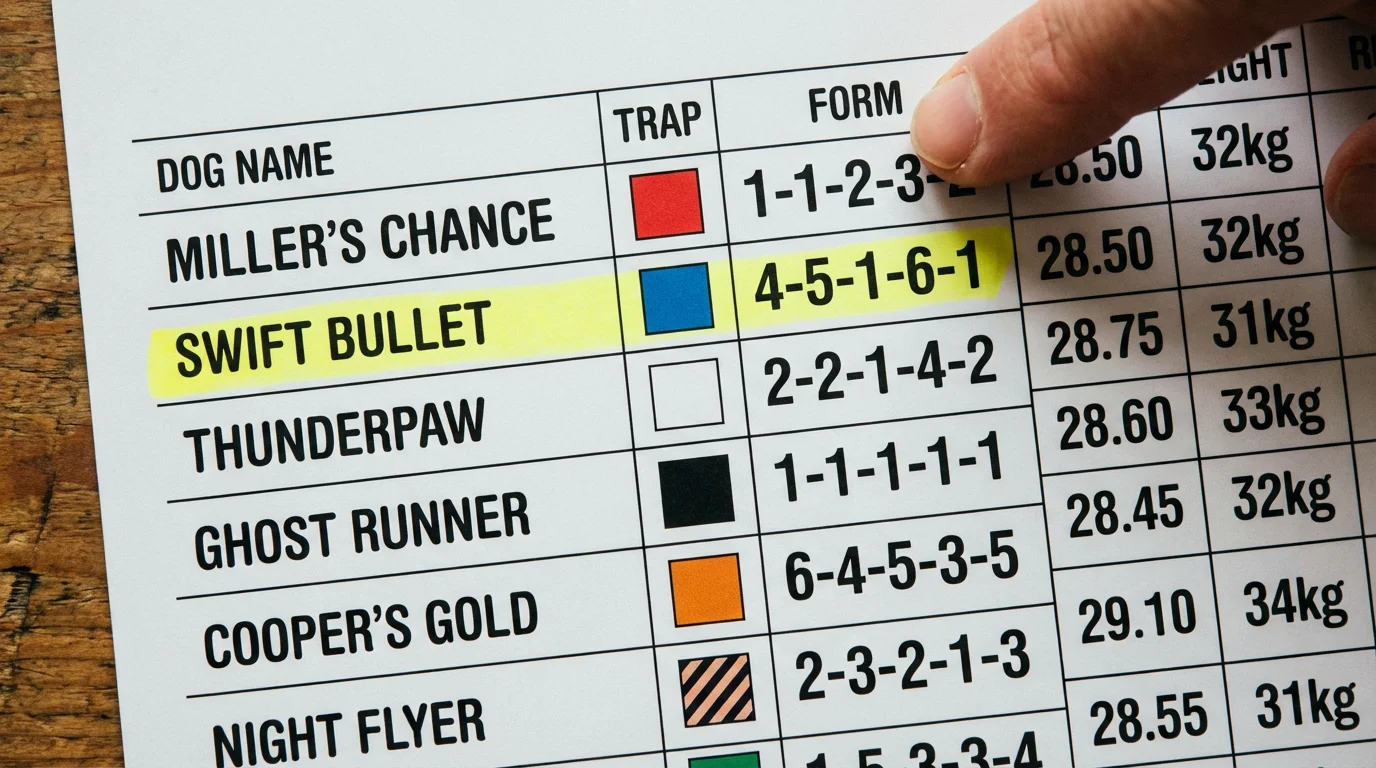
The dog’s name sits at the top of its card entry and is paired with a trap number and colour. In greyhound racing, trap colours are standardised across every licensed track in Britain: trap 1 is red, trap 2 blue, trap 3 white, trap 4 black, trap 5 orange, and trap 6 is striped (black and white). These are not decorative — they correspond to the actual jacket the dog wears during the race, making it possible to follow the action from the stands or on a stream. In Derby heats, the trap draw changes each round, so a dog that wore the red jacket in round one might wear orange in round two. The name stays the same. The trap doesn’t.
Next to the name you’ll find the trainer. In greyhound racing, the trainer is the single most important human figure in a dog’s performance. Unlike horse racing, where jockeys have a significant influence, greyhounds run without human intervention once the traps open. The trainer’s role — conditioning, trial preparation, weight management, race selection — determines whether a dog arrives at the traps in peak form or carrying fatigue. In the Derby, trainer form is a legitimate betting angle. Some trainers have a demonstrable track record of peaking their dogs for the big nights. Others campaign their teams more evenly across the calendar. The racecard tells you who trains the dog. Your research tells you what that means.
Form figures appear as a sequence of numbers and letters, typically showing the dog’s finishing positions in its last six races. A form line of 111232 tells you the dog’s recent finishing positions, with the most recent result on the far right. Letters indicate specific outcomes: F means fell, T means trap trouble at the start, and a dash indicates a period of absence. In Derby racecards, these form figures carry particular weight because they show you how a dog performed across different rounds of the competition. A form line that reads 1112 across four Derby rounds paints a clear picture of a dog that dominated the early stages but faced a tougher challenge in the later rounds.
Finishing times are displayed in seconds, typically to two decimal places, and represent the clock time for the race distance. At Towcester over the 500-metre Derby trip, a fast time sits around 28.50 to 29.00, while a standard competitive heat might produce times around 29.20 to 29.60. Some racecards also show a calculated time, which adjusts the actual running time for factors like track conditions and going — providing a more comparable figure across different race nights. Calculated times are more useful for form analysis than raw clock times because they normalise for conditions. A 29.30 on a wet night might represent a faster performance than a 29.10 on a fast surface, and the calculated time reflects that.
Weight is listed in kilograms and typically ranges from around 26 to 36 kg for dogs competing at Derby level. Weight fluctuations between races can signal changes in condition — a dog that has dropped a kilo since its last run might be coming in fitter and leaner, while a significant gain could indicate freshness from a rest period or, less favourably, a loss of peak conditioning. In the Derby specifically, where dogs race weekly across six rounds, tracking weight changes from round to round gives you insight into whether a dog is maintaining its form or beginning to feel the strain of a prolonged campaign.
The grade tells you the classification level the dog normally races at. Greyhound grades in Britain run from the highest (open class, typically denoted as OR) down through A1, A2, A3 and so on. Most Derby contenders race at open class or A1 level. The grade on the racecard tells you the standard of competition the dog is accustomed to — a dog stepping up from A2 to face open-class rivals in a Derby heat faces a significant jump in quality. Breeding information — sire and dam — is also listed and provides a longer-term perspective on the dog’s potential, though most punters focus on recent form rather than pedigree for immediate betting purposes.
Finally, some racecards include additional notes: comments from the race analyst on running style (front-runner, closer, railer, wide runner), sectional times showing how fast the dog covered the early portion of the race, and trap performance records showing the dog’s record from specific starting positions. Not every card includes every field, but the more data points you can access, the sharper your assessment becomes.
From Numbers to Narrative
Reading individual data points is the easy part. The skill lies in combining them into a holistic assessment — a narrative of how a specific dog is likely to perform in a specific race against specific opponents. This is where the racecard becomes genuinely powerful, because no single element tells the whole story.
Start with the form figures and ask: is this dog improving, declining, or consistent? A sequence that starts with twos and threes and finishes with ones suggests a dog hitting its stride at the right time — potentially useful in the later Derby rounds. A reverse pattern — early wins followed by declining finishing positions — might indicate fatigue, worsening draw luck, or stiffer competition. Neither reading is definitive on its own, but it sets the direction for your analysis.
Then cross-reference the times. A dog whose form figures show it winning easily in round one but scraping through in round two might still be running faster times in round two — which would suggest the competition stiffened but the dog’s actual performance improved. Without checking the times, you’d see a dog losing momentum. With the times, you see one maintaining its level against better opponents. That’s a crucial distinction for betting purposes.
Now add the trap draw. Your selection has strong form and quick times, but it’s drawn in trap 6 tonight after racing from trap 2 in its previous three starts. Does its running style accommodate the wider draw? Check the running comments — if it’s described as a wide runner or a closer, trap 6 might suit. If it’s a front-running railer, the wide draw creates a problem the form figures alone don’t reveal.
Weight and trainer complete the picture. A half-kilo drop in weight combined with improving times and a trainer known for peaking dogs at major events builds a compelling case. The same form figures with a weight increase and a trainer whose Derby record is poor builds a less convincing one. The racecard doesn’t make the decision for you, but it gives you every piece of information you need to make the decision yourself.
In the Derby, the luxury of multiple rounds means you can build a progressive picture of each dog across three, four, five racecards. A dog’s round-one card tells you how it handled Towcester for the first time. Its round-three card tells you whether it’s adapting or struggling. By the semi-final, you have a dataset deep enough to make genuinely informed selections — but only if you’ve been reading the cards properly from the start.
Card to Confident Selection
The racecard is a starting point, not a finishing line. It gives you the data. Your job is to turn that data into a view — on the likely winner, on the value in the market, on the bets that make sense given what the numbers are telling you. The punters who use racecards most effectively don’t just scan the form figures and back the dog with the most ones. They read across every column, compare the data between runners in the same race, and look for the discrepancies that the market might be underpricing.
A dog with slightly inferior form figures but a significantly better trap draw might be the smarter bet in a specific heat. A dog with the fastest time in the competition but a weight gain and a wide draw might be vulnerable despite its headline numbers. These are the judgements the racecard enables — and they’re the judgements that, over the course of a six-round Derby competition, separate profitable punters from the rest.
Every serious bet starts with the card. Make sure you know how to read yours.