Irish vs English Greyhound Derby: A Comparison
Best Greyhound Betting Sites – Bet on Greyhounds in 2026
Loading...
Two Derbies, Two Countries
Two Derbies. Two countries. One question: which produces the better dogs? The English Greyhound Derby and the Irish Greyhound Derby are the twin pillars of greyhound racing in these islands. Both are six-round knockout competitions run across six weeks, both attract the highest-quality fields their respective countries can assemble, and both carry prize money that dwarfs every other domestic event. They share a name, a format, and a position at the summit of the sport. But the differences between them — in venue, surface, distance, timing, and the culture that surrounds each — are significant enough to make them distinct competitions requiring distinct analytical approaches.
For bettors with an interest in both events, understanding those differences is essential. A dog that dominates the Irish Derby at Shelbourne Park doesn’t automatically replicate that form at Towcester. The reverse is equally true. The tracks produce different kinds of champions, and the challenge of the dual-Derby campaign — contesting both events in the same season — has historically proven one of the hardest feats in the sport. Only one dog, Toms The Best, has managed to win both — the Irish Derby in 1997 and the English Derby in 1998.
Format, Venue and Distance Compared
Both competitions use the same fundamental structure: six rounds of heats, with the field narrowing from roughly 180 entries to six finalists. Qualifying rules are essentially identical — the top three from each heat progress in the early rounds, with the field tightening as the competition advances. The knockout format tests durability, consistency, and the ability to peak across multiple weeks rather than in a single race. On paper, the two Derbies are structurally interchangeable.
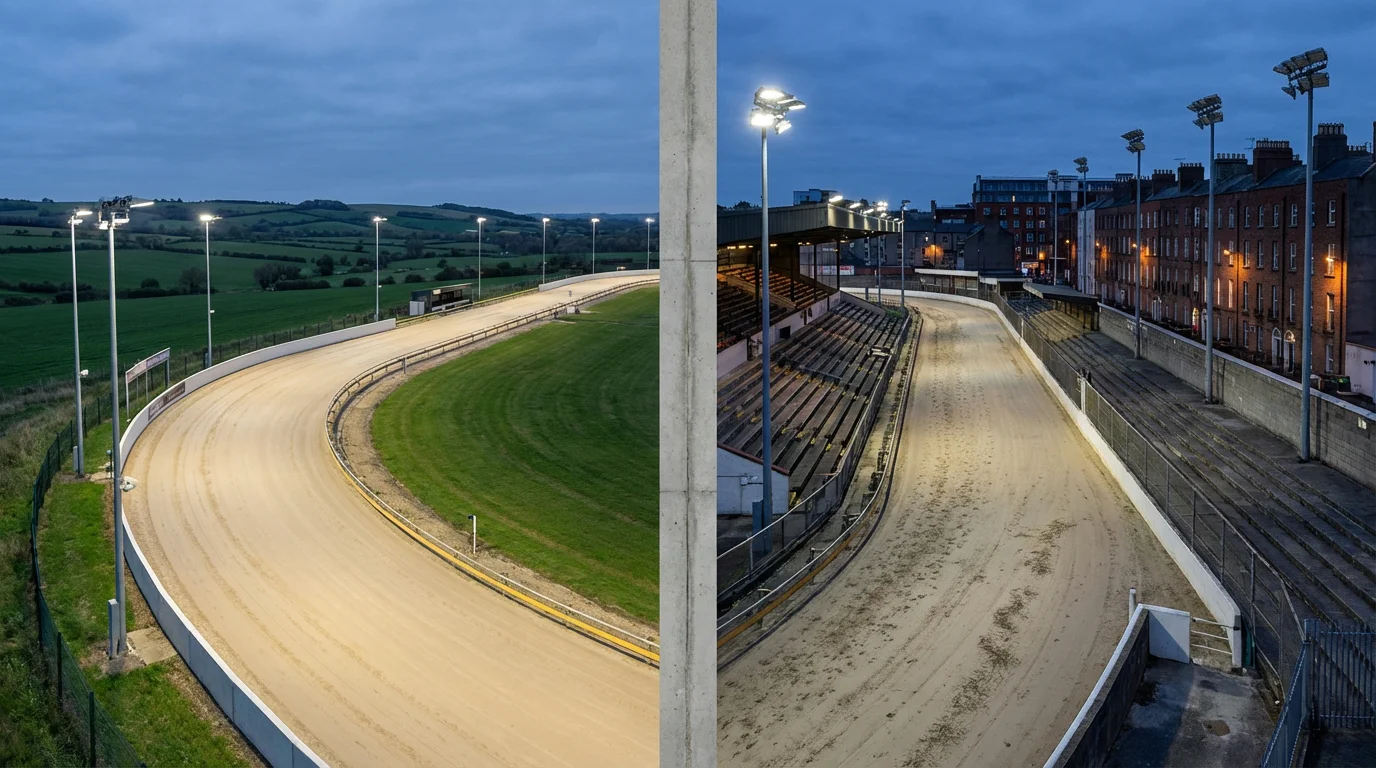
The venues, however, could hardly be more different. The English Derby is run at Towcester Greyhound Stadium, a modern purpose-built track in rural Northamptonshire with a 420-metre circumference, wide sweeping bends, and an all-sand surface. Shelbourne Park in Dublin — home of the Irish Derby since 1970, with a major refurbishment completed in 2024 — is a tighter, more traditional circuit. The running surface, the bend geometry, and the track atmosphere are all distinct. Dogs that relish Towcester’s width and long run to the first bend may find Shelbourne’s tighter configuration less accommodating, and vice versa.
Distance is another key distinction. The English Derby is run over 500 metres. The Irish Derby is run over 550 yards, which equates to approximately 503 metres — a marginal difference on paper, but one that can matter at the highest level. The extra few metres at Shelbourne slightly favour dogs with stamina reserves, while Towcester’s 500 metres, combined with its wider bends and longer straights, can suit speedier types who maintain pace through the turns. The surface difference reinforces this: Towcester’s sand is physically demanding in a way that Shelbourne’s track isn’t, and the combined effect of distance and surface means the two Derbies can reward subtly different physical profiles.
Prize money reflects the commercial realities of each market. The English Derby winner collects £175,000 — the richer prize. The Irish Derby winner receives €125,000 (roughly £107,000 at current exchange rates). The English prize attracts Irish dogs across the water; the Irish prize keeps many of the best dogs at home for the summer. For trainers managing top-class greyhounds, the decision of whether to target the English Derby, the Irish Derby, or both is partly financial, partly logistical, and partly based on which track suits their dog.
Timing is the final structural difference. The English Derby runs from May to June. The Irish Derby traditionally occupies a late-summer slot, typically August to September. This separation is deliberate — it allows dogs to contest both events in the same year without overlap, though the physical demands of back-to-back six-week campaigns are considerable. Dogs that emerge from the English Derby with heavy legs may struggle to replicate their form at Shelbourne two months later, particularly if they raced deep into the Towcester competition.
Cross-Derby Trends and Irish Dominance
The most striking trend in recent English Greyhound Derby history is the dominance of Irish-trained dogs. From 2017 onwards, Irish trainers have won the English Derby in the majority of renewals, often with dogs that were specifically prepared for the Towcester competition rather than campaigned at English tracks year-round. The depth of the Irish breeding pool, the strength of the training infrastructure centred around operations in Tipperary, Cork, and Kerry, and the tradition of targeting the English Derby as the ultimate prize have combined to create a competitive imbalance that British trainers have struggled to address.
Graham Holland’s Riverside Kennels in Tipperary has been the most prominent example. Holland, who holds the record for Irish Derby wins with five, has also sent multiple runners to the English Derby, including 2025 finalists Bockos Diamond, Cheap Sandwiches, and Bombay Pat. His ability to prepare large teams for both competitions reflects a scale of operation that few British kennels can match. Patrick Janssens, based in Britain but Belgian-born, has been one of the few non-Irish trainers to break through at the English Derby in recent years, winning with Thorn Falcon in 2021 and Droopys Plunge in 2025.
The dual-Derby campaign — winning both the English and Irish Derby — remains the sport’s holy grail. Toms The Best completed the double across 1997 and 1998, winning at Shelbourne Park first and then at Wimbledon. Since then, several dogs have attempted the feat. Bockos Diamond, the 2024 Irish Derby champion, was the 2025 English Derby favourite but finished second to Droopys Plunge. The challenge is partly physical: twelve rounds of knockout competition across two countries, on different surfaces and at different distances, over roughly four months. But it’s also tactical. Trainers must balance peaking for the English Derby in June with maintaining enough condition and freshness to compete at the Irish Derby in September. Most prioritise one event and treat the other as a secondary target.
For bettors, cross-Derby form analysis is a valuable tool. Dogs that performed well at the English Derby but didn’t win may arrive at the Irish Derby with their ability proven but their price longer than it should be — the market sometimes undervalues English Derby form when pricing the Irish event, and vice versa. Similarly, tracking which Irish trainers send their strongest teams to England can help identify ante-post value before the English Derby entries are even confirmed.
One Sport, Two Stages
The English and Irish Derbies are not rivals. They’re partners — two expressions of the same sport’s highest ambitions, staged on different surfaces, at different times, in different countries, but united by a shared format and a shared pool of elite dogs. The best greyhounds in the world contest both. The best trainers prepare for both. And the best bettors analyse both, because form from one Derby informs selections at the other in ways the casual market often overlooks.
Whether you focus on the English Derby, the Irish Derby, or both, the analytical principles are the same: assess the dog’s suitability for the specific track, evaluate the trainer’s record in the specific competition, and monitor the physical toll of the knockout format across six weeks. The details differ. The framework doesn’t. Two Derbies. Two stages. One sport at its very best.