Greyhound Derby Format: Rounds, Heats and How It Works
Best Greyhound Betting Sites – Bet on Greyhounds in 2026
Loading...
More Complex Than Most Punters Realise
The format is the engine of the Derby — and it’s more complex than most punters realise. The English Greyhound Derby is not a single race. It’s a six-round knockout competition that runs across six weeks, starting with roughly 180 entries and eliminating dogs round by round until six finalists line up for the showpiece. That structure — the progressive elimination, the weekly racing, the changing trap draws, the shifting competitive balance — is what makes the Derby fundamentally different from any standard greyhound meeting. It’s also what makes it one of the most analytically rich betting events in the sport.
Understanding how the format works isn’t just background information. It directly affects betting strategy at every stage of the competition. The qualifying rules determine which dogs progress and which are eliminated. The heat configuration determines which dogs face each other, and when. The round-by-round schedule determines the physical demands placed on each dog and the recovery time available between races. Punters who treat the Derby as six separate rounds of individual races miss the structural dynamics that link those rounds together.
Round by Round: From 180 to Six
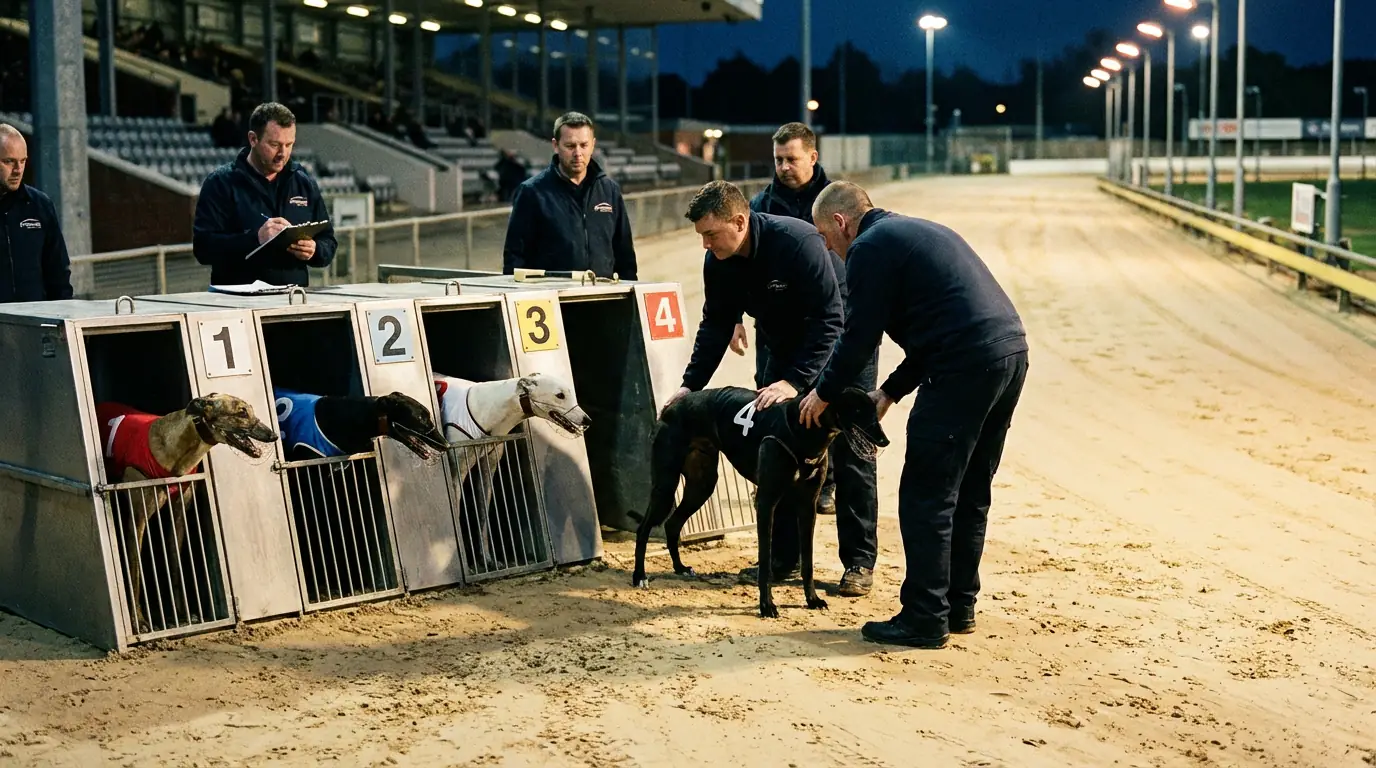
The competition begins with the entry deadline, typically in late April or early May. The 2025 Derby attracted 179 entries. These entries are divided into first-round heats of six dogs each, producing roughly 30 heats across the opening weekend. The heats are run over two or three evenings, with the full first-round card typically completed within a single weekend at Towcester.
In the first round, the top three finishers in each heat qualify for the second round. The bottom three are eliminated. This means that approximately half the field is cut after a single race. For ante-post bettors, the first round is the most dangerous stage — your selection could be eliminated in its opening race if it encounters a bad trap, a slow start, or simply a heat that’s more competitive than expected. The first-round draw, which determines which dogs face each other, is released before the round and is a significant market mover. Dogs drawn in weak heats with clear opposition shorten in the ante-post market. Dogs drawn against strong rivals in their opening heat may drift.
The second round follows the same format: six-dog heats, top three qualify. The field is now roughly 90 dogs, and the quality has increased noticeably. The weakest entries were eliminated in round one, and every surviving dog has at least one Towcester run under its belt. For form analysts, the second round is where the real data begins — you can now compare dogs’ round-one performances, assess how they handled the track, and cross-reference their times against the going on the night.
The third round reduces the field again, and from this point the competition begins to tighten significantly. With roughly 48 dogs remaining, the heat quality is high across the board. There are fewer weak heats and fewer obvious eliminations. The third-round draw becomes critical because the dogs you face now are genuine contenders, and a tough draw can end a campaign that was progressing comfortably.
The quarter-finals mark the point where the competition shifts from a mass-participation event to an elite tournament. Approximately 24 dogs remain, divided into heats where every runner has proven form at Towcester across three rounds. The top three from each quarter-final heat advance to the semi-finals. The intensity increases — the quality of opposition, the scrutiny on each dog’s performance, and the betting market’s attention all step up. At this stage, most ante-post prices on the outright market have shortened considerably, and the value windows are narrow.
The semi-finals are two heats of six, with the top three from each progressing to the final. This is the round where the Derby often produces its most dramatic moments. Twelve dogs remain, all genuine contenders, and the three that don’t qualify from each heat are eliminated agonisingly close to the final. The semi-final draw — which six dogs face each other in which heat — can have a decisive influence on which dogs reach the final. Two strong front-runners drawn in the same semi can compromise each other, allowing a closer to pick up a qualifying place they might not have earned in the other semi.
The final brings together the six survivors. One race. Six dogs. One winner. The Derby final is run on a Saturday evening, typically in mid-June, and the single-race, winner-takes-all format means that anything can happen — and frequently does. Dogs that dominated the early rounds can encounter bad luck at the traps, interference at the first bend, or simply a rival that peaks on the biggest night. The format ensures that the final is not a coronation. It’s a race, with all the uncertainty that implies.
How the Format Shapes Betting
The knockout format creates specific dynamics that sharp bettors can exploit. The first and most important is fatigue. Dogs race weekly across six rounds, always at Towcester, always over 500 metres, always on sand. By the semi-final, every surviving dog has run five competitive races in five weeks. Some dogs handle this workload comfortably — their weight remains stable, their times are consistent, their running style doesn’t deteriorate. Others begin to show signs of fatigue: slightly slower times, a loss of early pace, or a drop in weight that suggests they’re not recovering fully between rounds.
Tracking these physical indicators across rounds is one of the most underused analytical tools in Derby betting. The racecard gives you weight, time, and finishing position for each round. Plotting a dog’s trajectory across those data points reveals whether it’s peaking, plateauing, or declining — information that’s far more valuable than looking at any single round in isolation.
The draw rotation is another format-driven factor. Dogs receive a new trap draw in each round. A dog that raced from trap 1 in round one might get trap 5 in round two and trap 3 in the quarter-final. This means that flexible runners — dogs capable of winning from any trap — carry less draw-related risk than trap-dependent specialists. A front-runner that needs an inside draw to show its best form is vulnerable to an outside trap in a key round, and the market doesn’t always fully price in that risk.
Progression paths matter too. A dog that has qualified comfortably — winning its heats by two or three lengths, posting the fastest times in its section of the draw — enters the semi-final with less physical expenditure than a dog that scraped through by a short head in every round. Both have the same record of five qualifications, but the comfortable qualifier has more energy in reserve. In a semi-final or final where margins are tight, that reserve can be the difference.
Finally, the format rewards consistency above brilliance. A dog that posts a spectacular time in one round but an average time in the next is less reliable than a dog that runs 29.20, 29.15, 29.18, 29.22 across four rounds. The knockout structure punishes volatility because one bad performance means elimination. Bettors who prioritise consistency in their Derby selections — looking at the range of a dog’s times across rounds rather than just the best single performance — tend to fare better across the competition.
Built to Expose, Not to Flatter
The Derby format is deliberately punishing. Six rounds over six weeks, on the same track, at the same distance, with the field quality increasing every round. It’s designed to find the best all-round greyhound in Britain and Ireland, and it achieves that by testing every attribute a racing dog can possess: speed, stamina, adaptability, temperament, and the ability to perform under pressure on the biggest nights.
Dogs that win the Derby don’t just have the fastest time or the strongest early pace. They have the durability to sustain their form across six weeks, the versatility to win from different traps, and the composure to handle the heightened atmosphere of a semi-final or final night. The format exposes pretenders ruthlessly — a dog that’s fast but fragile, or brilliant but inconsistent, will be found out long before the final.
For bettors, the lesson is clear: assess the format, not just the form. The dog with the best single run in the competition is not necessarily the best bet for the final. The dog that’s been doing everything right, round after round, without ever catching the eye — that’s the one the format was built to reward.