Greyhound Derby Each-Way Betting: Place Terms and Tips
Best Greyhound Betting Sites – Bet on Greyhounds in 2026
Loading...
Each-Way: The Derby’s Insurance Policy
Each-way isn’t playing it safe. In the right Derby heat, it’s playing it smart. The term “insurance policy” gets thrown around loosely in betting circles, usually by people who haven’t bothered to calculate whether the insurance is actually worth paying for. In the English Greyhound Derby, each-way betting occupies a more interesting space than that. The competition’s structure — six rounds of elimination, shrinking fields, and a generous ante-post place market — creates specific conditions where each-way wagers aren’t just a safety net. They’re a standalone profit strategy.
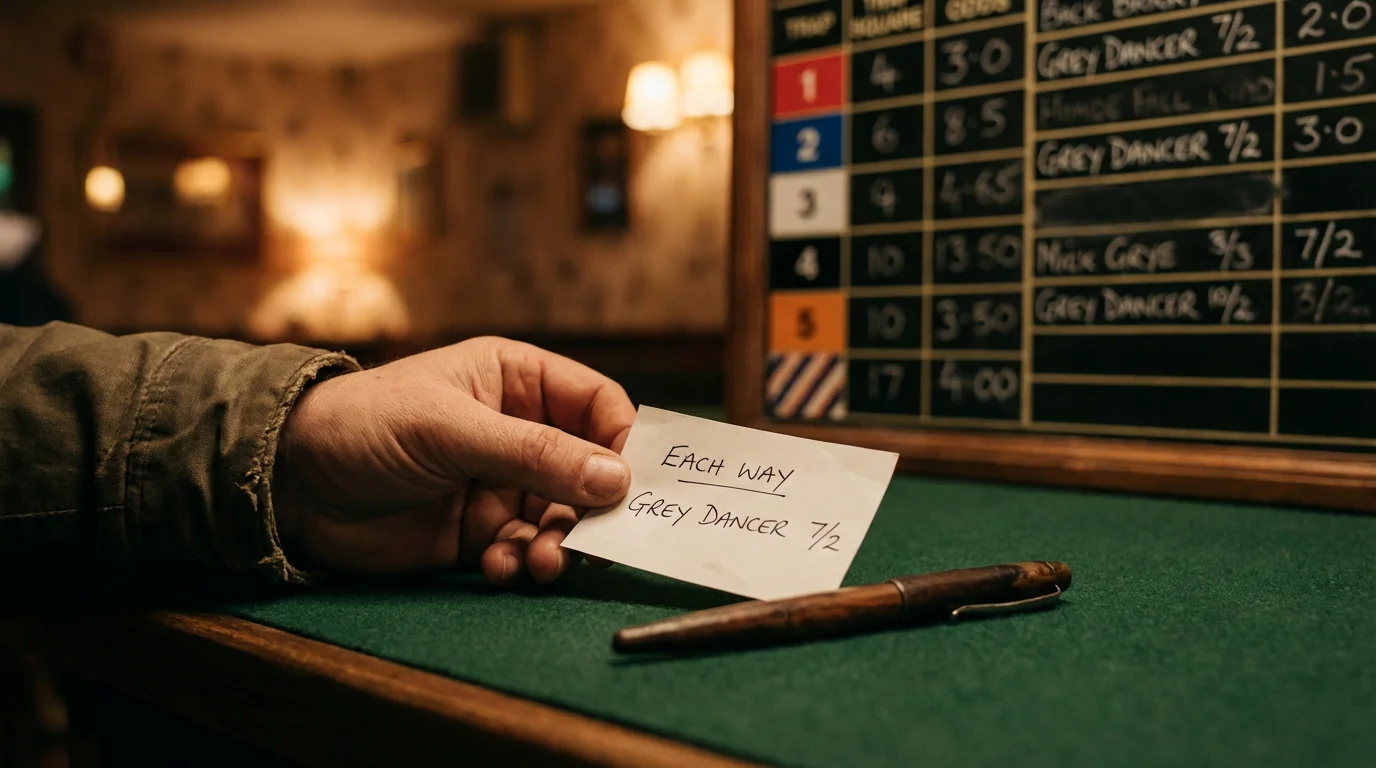
An each-way bet is two bets in one. The first is a win bet: your dog finishes first, you collect at full odds. The second is a place bet: your dog finishes in the places (the exact definition of “places” depends on the race and the bookmaker’s terms), and you collect at a fraction of the win odds. You pay double the unit stake because you’re placing two separate wagers. If the dog wins, both bets pay out. If it places but doesn’t win, only the place portion returns. If it finishes outside the places, you lose both stakes.
What makes the Derby different from a standard Tuesday evening card is the place-term structure on the outright ante-post market. In individual Derby heats — six-dog races — the standard place terms are limited. But on the outright Derby winner market, bookmakers often pay out on the first five or six places, meaning your dog only needs to reach the final to trigger the place portion of your each-way bet. That changes the mathematics entirely.
Understanding Place Terms for Derby Races
Place terms define whether each-way is genius or a waste of half your stake. Getting this right is non-negotiable — the difference between profitable each-way betting and pointless each-way betting lives entirely in the terms.
For individual Derby heats and rounds, the place terms follow standard greyhound racing conventions. In a six-runner race, most bookmakers pay two places at one-quarter of the win odds. So if your dog is 6/1 and finishes second, your place return is calculated at 6/4 (one-quarter of 6/1) multiplied by your stake. First place pays the full 6/1 win portion plus the 6/4 place portion. Anything outside the first two pays nothing.
The outright ante-post market, however, is where each-way terms become significantly more attractive. Major UK bookmakers typically offer each-way terms of one-quarter the odds for places one through six on the Derby outright winner market. In practical terms, this means your dog needs to reach the six-dog final to qualify for a place payout. Given that 180-plus dogs enter the first round, reaching the final is a genuine achievement — but it’s considerably more likely than winning the whole competition. A dog at 20/1 ante-post, backed each-way at one-quarter odds for six places, returns 5/1 on the place portion if it reaches the final. At a £10 each-way stake (£20 total), that’s a £50 place return plus your £10 stake back — a £40 profit even if the dog doesn’t win the final.
The calculation shifts depending on the bookmaker. Some may offer one-fifth the odds rather than one-quarter, which reduces the place return. Others may extend the places to cover the semi-finalists (12 places), which broadens the safety net but typically at shorter fractional odds. Before placing any each-way Derby bet, check the specific terms offered by your bookmaker. The information is always displayed alongside the market — look for the notation that reads something like “1/4 odds, places 1-2-3-4-5-6.”
Here’s a worked example to make the numbers concrete. Suppose you back a dog at 33/1 each-way on the outright Derby winner market, with terms of one-quarter odds, six places. Your stake is £5 each-way, so £10 total outlay. If the dog wins the Derby, you receive: £165 (win at 33/1) plus £41.25 (place at 33/4) plus your £10 stakes back — total return of £216.25. If the dog reaches the final but doesn’t win, you receive: £41.25 (place at 33/4) plus the £5 place stake back — total return of £46.25 on a £10 outlay. And if the dog is eliminated before the final, both bets lose and you’re down £10. The asymmetry is clear: a modest outlay can produce a significant return even without a win, provided the terms are right and the dog is good enough to go deep in the competition.
When Each-Way Bets Make Sense in the Derby
If the dog’s got a real chance of making the final, the each-way is half won already. But that condition is doing a lot of heavy lifting — not every dog at a big price is a genuine each-way proposition, and not every stage of the Derby rewards each-way betting equally.
The strongest case for each-way betting arises in the ante-post outright market when backing a dog at double-figure odds that you believe has a realistic path to the final. This typically means a dog with proven open-class form, a trainer with a Derby track record, and no obvious draw or physical obstacle that would prevent it from progressing through six rounds. At 16/1 or longer with six-place terms, the place portion of the bet carries genuine independent value. You’re not just hoping for a miracle win — you’re constructing a bet where the place leg has a reasonable probability of success on its own merits.
The maths works less well at shorter prices. An each-way bet on the 3/1 favourite offers a place return of just 3/4 — less than evens. At those odds, the place portion barely justifies the additional stake. You’d need to be highly confident the favourite will reach the final (which is likely, but not certain in a six-round knockout) and you’d need the place return to feel adequate for the capital tied up. For most punters, a win-only bet at short prices is cleaner and more capital-efficient than each-way.
Within individual Derby heats, each-way betting has a narrower application. Standard six-runner place terms (two places, one-quarter odds) mean your dog needs to finish in the top two. In competitive heats — where the first three qualify anyway — an each-way bet is essentially backing your selection to qualify, plus a win kicker. That’s useful when you fancy a dog to progress but aren’t sure it’ll win the specific heat. The danger is in weak heats where one or two runners are clearly inferior: the short prices on the top dogs reduce the each-way value, and you might be better off with a forecast or a win bet on a specific contender.
Semi-finals present an interesting each-way scenario. By this stage, the 12 remaining dogs are all genuine contenders, and the competitive balance tends to be tighter than in the early rounds. Each-way in the semi-finals — where two places are paid — effectively backs your dog to reach the final. If you already hold an ante-post each-way bet on the same dog, an additional semi-final each-way creates a layered position: the semi-final each-way covers the final qualification, while the ante-post each-way covers the final itself. Used carefully, this layering can produce a situation where you’re profitable regardless of the final result.
When should you avoid each-way? When the price is too short for the place terms to justify the extra stake. When you’re backing a dog in a weak heat where the favourite is odds-on. When you’re using each-way as a psychological crutch rather than a calculated position — the “I think it’ll place but probably won’t win” mindset, which often just means you haven’t done enough research to commit either way.
Two Bets, One Slip, One Mindset
The punters who profit from each-way bets don’t see them as insurance. They see them as two separate wagers — and price them accordingly. That distinction matters more than it sounds. When you back a dog each-way at 20/1 in the ante-post Derby market, you’re not placing one bet with a safety net attached. You’re placing a 20/1 win bet and a 5/1 place bet. Both need to be justified independently. The win bet needs to offer value at 20/1 — does this dog genuinely have a better chance of winning the Derby than one in twenty? The place bet needs to offer value at 5/1 — does it have a better than one-in-six chance of reaching the final?
If both legs pass that test, the each-way is sound. If only the place leg passes — you think the dog can make the final but probably can’t win it — then a place-only bet (where available) is more efficient. And if neither leg looks like value, no amount of each-way comfort should convince you to back the dog at all.
Treat the each-way slip as what it is: two bets, two assessments, one decision. The Derby rewards that level of precision. It punishes everything else.