Greyhound Breeding and Bloodlines for Bettors
 Available in US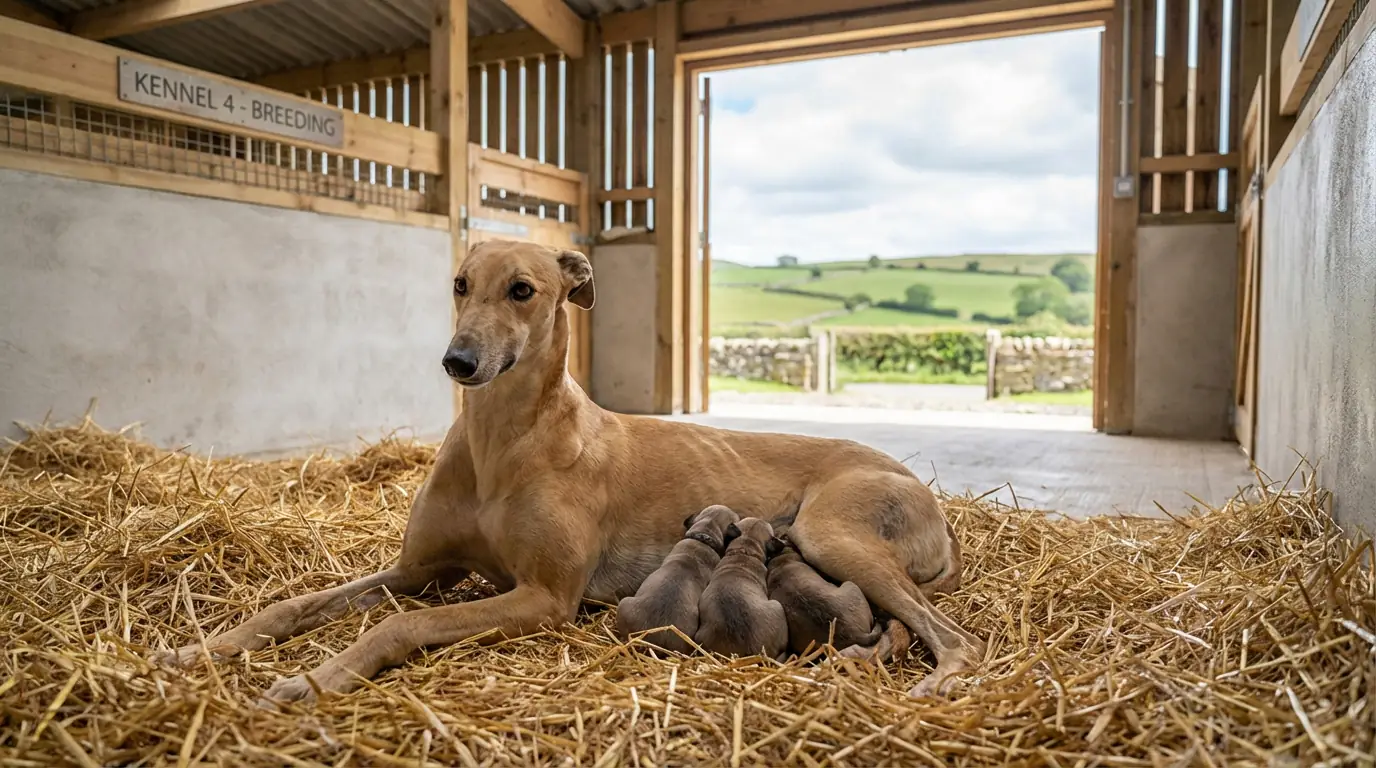
The Story Starts Before the Traps
The Derby winner’s story doesn’t start at the traps. It starts with the sire and dam. Every greyhound that lines up in a Derby heat is the product of deliberate breeding decisions made two to three years before the competition — decisions about which sire to use, which dam to breed from, and which physical and behavioural traits to prioritise in the resulting litter. For most punters, breeding information sits at the bottom of the racecard and is ignored in favour of form figures and times. But for bettors willing to look deeper, pedigree provides a supplementary form angle that can reveal abilities — and limitations — that recent race results alone don’t capture.
Greyhound breeding in Britain and Ireland is concentrated among a relatively small number of dominant sire lines, and the influence of these bloodlines on Derby performance is measurable. Certain sires consistently produce offspring with early pace. Others produce stayers. Some bloodlines thrive on sand surfaces; others prefer the firmer going at specific tracks. Understanding which bloodlines tend to excel in the Derby context — over 500 metres at Towcester, on sand, across six rounds — adds a dimension to your analysis that the mainstream market rarely prices in.
Apply bloodline knowledge to your form analysis in derby form guide.
Dominant Sire Lines in Modern Derby Racing
The modern English Greyhound Derby is dominated by a handful of sire lines that have produced multiple finalists and winners over the past decade. Identifying these bloodlines helps bettors assess the genetic potential of Derby entries, particularly young or lightly raced dogs whose race form alone doesn’t tell the full story.
Dorotas Wildcat, the 2018 Derby winner trained by Kevin Hutton, has become one of the most influential active sires in British greyhound racing. His offspring tend to inherit his combination of early pace and the physical robustness required to handle sand surfaces over 500 metres. When a young dog by Dorotas Wildcat enters the Derby with limited but promising race form, the pedigree provides additional confidence that the dog has the genetic toolkit for the competition — strong trapping, sustained speed through bends, and the durability for weekly racing.
Lenson Bocko, the 2019 Irish Derby champion trained by Graham Holland, has become a notable sire of open-class greyhounds in Ireland, and his offspring regularly cross the Irish Sea for the English Derby. Dogs sired by Lenson Bocko tend to be powerful, middle-distance specialists with strong finishing speed — De Lahdedah, the 2024 English Derby champion, is among his progeny. The “Bockos” prefix in a dog’s name identifies it as bred by Joseph O’Connor rather than denoting a specific sire line: Bockos Diamond, the 2024 Irish Derby champion and 2025 English Derby finalist, is sired by Dorotas Wildcat rather than Lenson Bocko. When you see multiple Bockos-named dogs in the Derby entries, you’re looking at a breeding operation that has been specifically targeted at the competition.
Ballymac sire lines from the Dowling family’s kennel in Kerry have been a consistent presence in both Irish and English Derbies. Ballymac-prefixed dogs are bred from a programme that prioritises versatility and temperament — traits that serve well in a six-week knockout competition where adaptability matters as much as raw speed. The Ballymac bloodlines tend to produce dogs that handle different trap draws and different paces without losing their competitive edge. The 2024 English Derby winner De Lahdedah, trained by Liam Dowling, is a product of this lineage.
Droopys sire lines, associated with the Dunphy family’s breeding operation in Portlaw, County Waterford, have produced multiple Derby runners and winners. The 2025 champion Droopys Plunge was trained by Janssens but bred by Sean Dunphy, continuing a line that includes Droopys Scholes (2004 winner, trained by Ian Reilly). The Droopys breeding programme has historically emphasised early pace and trapping speed, which suits Towcester’s long run to the first bend. Dogs from these lines often perform well from inside traps where their early speed can establish an uncontested lead.
Irish breeding dominates the modern Derby. The majority of entries — and the majority of winners in the Towcester era — have been bred in Ireland, where the scale of the breeding industry and the depth of the bloodline database far exceeds Britain’s. Irish breeders like the Dunphy family, Joe Kennedy, and Mary Kennedy have produced multiple Derby runners from carefully managed brood bitches, and the concentration of breeding expertise in counties Tipperary, Cork, and Kerry gives Irish-bred dogs a statistical advantage before they even set foot on a racetrack.
Using Pedigree as a Betting Angle
Pedigree analysis is most valuable when applied to dogs with limited race form — typically young dogs or those making their Derby debut. A two-year-old entering its first Derby with just eight or ten career races has a thin form profile. The racecard tells you it’s won four of eight. The times give you a baseline. But the pedigree tells you something the form can’t: whether this dog’s genetic profile suggests it can improve further, handle the specific demands of Towcester’s surface, and sustain performance across six rounds of knockout competition.
Sire influence on staying power is one of the clearest pedigree signals. Some sires consistently produce offspring that maintain speed over 500 metres and beyond. Others produce sprinters that peak over 400 metres but lack the stamina for the Derby distance. If a dog’s sire is known to produce stayers — as evidenced by the sire’s other offspring performing well over 500 metres and in competitions with multiple rounds — the Derby distance is less likely to find it out. Conversely, a dog sired by a noted sprinting influence may be quick enough to win early heats but vulnerable to stamina limitations in the later rounds.
Dam influence is equally important but harder to track. While sire records are publicly available and well-documented, dam records are less visible in mainstream racing media. Experienced bettors track the performance of dam families — the racing records of a dam’s other offspring — to assess whether a specific bitch produces runners that handle competition, pressure, and repeated racing well. A dam whose previous litter included a Derby semi-finalist is a stronger indicator of Derby suitability than one whose offspring have raced exclusively at lower levels.
Track-surface preference can be genetically influenced. Some bloodlines consistently produce dogs that perform better on sand than on other surfaces, and vice versa. If a sire’s offspring have a strong record at Towcester specifically — or at other sand-based tracks — this provides a useful supplementary indicator when assessing a Derby entry that hasn’t yet raced at the venue. Trial times at Towcester are the best direct evidence of track suitability, but in the absence of trial data, pedigree analysis offers a proxy.
Blood Tells
Breeding is a long game. It doesn’t replace form analysis, and it shouldn’t override what the racecard and the race footage are telling you. A dog with impeccable pedigree and poor form is a poor bet. But when two dogs have similar form, similar times, and similar draw prospects, the one with the stronger Derby pedigree — the one whose sire has produced previous Derby winners or finalists, whose dam family has a record of producing competition-tough runners — carries a slight but meaningful edge.
Check the pedigree. Note the sire. Research the dam family if you can. And when a lightly raced dog from a strong Derby bloodline produces a fast trial at Towcester, pay attention. The market may not have caught up with what the breeding is telling you. In a competition where margins are measured in fractions of a second and one good round can transform a dog’s price, pedigree is the edge hiding in plain sight on every racecard.
Explore breeding insights on the greyhoundderbybetting homepage.
