How Greyhound Derby Forecast Bets Work
 Available in US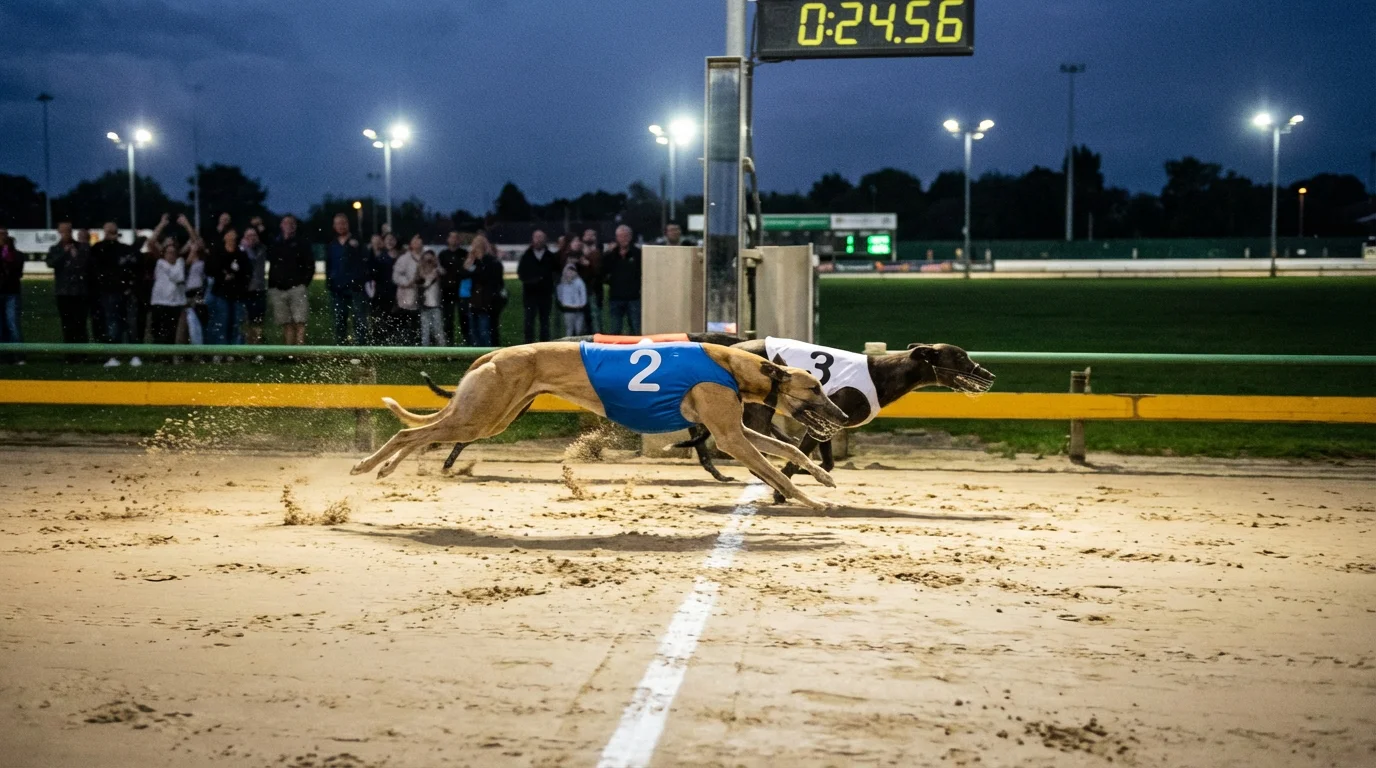
Thirty Possible Results, One Winning Slip
In a six-dog race, there are 30 possible exact-order results for the first two finishers. Forecasts let you pick the one that pays. That might sound like needle-in-a-haystack territory, but it’s not. Compared to horse racing — where fields of 12 or more create hundreds of permutations — a six-dog greyhound race keeps the maths manageable. And in the English Greyhound Derby, where the form book is scrutinised more heavily than in any other greyhound competition, informed punters can frequently narrow those 30 possibilities down to a handful of realistic outcomes.
A forecast bet requires you to predict which two dogs will finish first and second. In a straight forecast, the order must be exact — Trap 3 first, Trap 6 second, no other combination counts. The returns on a successful straight forecast can be substantial, because you’re doing something genuinely difficult: identifying not just the winner, but the runner-up, in the correct sequence. In Derby heats, where the standard of competition is high and margins are tight, a correctly called forecast routinely pays more than a simple win bet on the favourite. That’s the attraction. It’s also why forecast betting has become one of the defining features of greyhound wagering at every level, from the local flapping track to the Towcester Derby final.
Forecasts in the Derby carry an additional dimension because the form data is richer than in typical races. By the third or fourth round, you’ve seen every surviving dog race at Towcester at least twice. You know their sectional times, their trap preferences, their running styles. You can assess not just who’ll win, but who’ll fill the places — and that’s precisely the skill a forecast rewards.
Compare with tricast betting in tricast betting.
Straight Forecasts: Picking the Exact One-Two
A straight forecast is the purest form of forecast betting. You select one dog to finish first and another to finish second, in that exact order. If your selections hit in the right sequence, you collect. If the two dogs fill the first two places but in the wrong order, you lose. No partial credit.
The dividend for a straight forecast is not a fixed price offered by the bookmaker. Instead, it’s calculated using a formula (the Computer Straight Forecast, or CSF) that factors in the starting prices of the two dogs involved, the number of runners, and the overall shape of the market. The formula produces a dividend per £1 staked. In general terms, the more unlikely the combination — a long-priced winner and a long-priced runner-up — the higher the dividend. A forecast involving the two shortest-priced dogs in the race will pay the least.
Typical straight forecast dividends in Derby heats vary enormously. A forecast featuring the two market leaders might return somewhere between £5 and £15 for a £1 stake. A forecast combining the winner at 5/2 with a 4/1 runner-up might return £20 to £30. And when an outsider wins or places, dividends can reach three figures. In a typical Derby first round, several heats produce straight forecast returns above £50 for a £1 unit, driven by unexpected results in competitive fields.
The key skill in straight forecast betting is not just identifying two strong dogs, but determining their likely finishing order. This is where running style analysis becomes essential. A front-running dog with strong early pace drawn in trap 1 is more likely to lead than a closer drawn in trap 6 — even if the closer has the faster overall time. Conversely, if two dogs both like to lead and are drawn next to each other, crowding at the first bend could compromise both and create opportunities for a third dog to claim the runner-up spot.
In Derby heats specifically, where three dogs qualify from each race, there’s an additional wrinkle. The first and second are your forecast targets, but the third qualifier might be the dog most punters have been focusing on. Forecasts reward you for thinking about the gap between second and third — which dog just about holds on to the runner-up spot? That’s a different question from “which dog wins?” and it requires a different analytical lens.
Reverse and Combination Forecasts
If you’re confident two dogs will fill the first two places but can’t separate them in terms of finishing order, the reverse forecast offers a solution. A reverse forecast covers both possible sequences: Dog A first and Dog B second, or Dog B first and Dog A second. Because you’re covering two outcomes instead of one, a reverse forecast is two bets — so a £1 reverse forecast costs £2 in total stake. The dividend is calculated on the combination that actually occurs, still using the CSF formula, and paid on the single winning leg of the bet.
Reverse forecasts are particularly useful in Derby heats where two dogs stand out on form but the trap draw or running style makes their relative finishing order hard to call. Say Trap 2 and Trap 5 are clearly the two best dogs in a heat, but Trap 2 is a front-runner and Trap 5 is a closer who often nails late. The finish could go either way depending on the pace of the race. A reverse forecast covers both outcomes, and the dividend — while lower per leg than a straight forecast on the right combination — still represents good value if the two dogs genuinely are clear of the field.
The combination forecast extends this logic further. Instead of selecting just two dogs, you pick three or more and cover all possible exact-order permutations for the first two places. With three selections, the combination forecast includes six bets (3 dogs x 2 possible finishing orders for each pair). With four selections, it’s 12 bets. The cost scales accordingly — a £1 combination forecast with three dogs costs £6, with four dogs costs £12.
| Selections | Number of Bets | Cost at £1 Unit |
|---|---|---|
| 2 (reverse) | 2 | £2 |
| 3 (combination) | 6 | £6 |
| 4 (combination) | 12 | £12 |
| 5 (combination) | 20 | £20 |
| 6 (full field) | 30 | £30 |
The trade-off is straightforward: wider coverage costs more, which means the dividend needs to be larger to produce a profit. A £6 combination forecast with three dogs needs to return more than £6 to be worthwhile — and in a competitive Derby heat where your three selections are all relatively short-priced, the CSF dividend might struggle to exceed that threshold. Combination forecasts work best when at least one of your selections is at a bigger price, boosting the potential dividend above the cost of coverage.
There’s also the “field forecast” or “named favourite” approach, where you back one specific dog to win and combine it with the entire remaining field for second place. In a six-dog race, that’s five bets. This can be effective when you’re very confident about the winner but uncertain about the runner-up — a common scenario in Derby heats where one dog’s form is significantly superior to the rest. If an outsider fills the runner-up spot, the dividend can be substantial enough to offset the cost of covering the field.
Dividend Discipline
Understanding the dividend structure makes forecasts a skill, not a lottery. The CSF formula is not entirely transparent — bookmakers don’t publish the exact equation — but its behaviour is predictable enough for practical purposes. Dividends increase when less-fancied dogs are involved in the forecast result. Dividends shrink when the market leaders dominate. And the relationship between price and dividend is not linear: a slight upset in the runner-up position can double or triple the payout compared to the expected result.
This creates a strategic implication. If you’re going to bet forecasts regularly through the Derby, the value lies not in predicting the obvious one-two, but in correctly identifying at least one dog that the market has underpriced. A forecast involving the 2/1 favourite and the 3/1 second favourite will pay modestly. A forecast involving the 2/1 favourite and a 7/1 outsider will pay significantly more — and in a six-dog race, a 7/1 shot finishing second is far from impossible.
The disciplined approach is to treat forecast betting as a form analysis exercise with a higher bar than a simple win bet. You need to be right about two things simultaneously: who wins, and who runs second. Before placing a forecast, ask yourself whether you’ve genuinely assessed the runner-up question, or whether you’ve just picked the winner and paired it with the next name on the racecard. If it’s the latter, you’re not forecast betting — you’re guessing in a more expensive format.
Derby heats are among the best forecast opportunities in the greyhound calendar. The form is deep, the fields are well-analysed, and the competitive nature of the early rounds produces enough upsets to keep dividends interesting. Approach them with the right discipline, and forecasts can become a consistent tool in your Derby betting arsenal rather than an occasional gamble.
Find all Derby bet type guides on the greyhoundderbybetting homepage.
