History of the English Greyhound Derby: 1927 to Today
 Available in US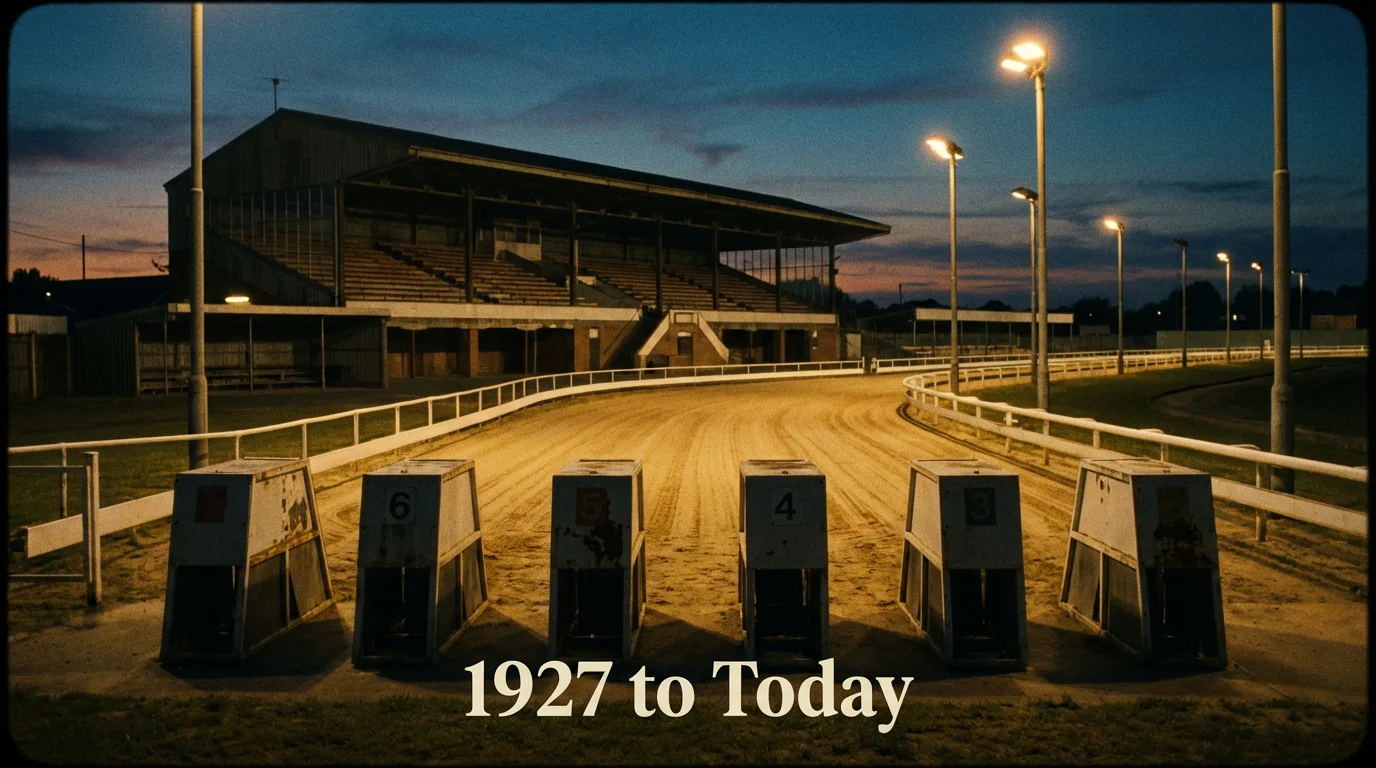
Almost a Century Under the Lights
The first English Greyhound Derby final was run on a Saturday evening in 1927 at White City Stadium in London, three years before the inaugural football World Cup in 1930 and in the same year as the first Ryder Cup. The winner was Entry Badge, trained by Joe Harmon, and the crowd numbered in the tens of thousands — part of a greyhound racing boom that was sweeping Britain in the late 1920s with an enthusiasm that is difficult to imagine from the vantage point of a modern BAGS meeting. The Derby was born into a sport that filled stadiums the way football does now, and for decades it held a place in the British sporting calendar that reached well beyond the racing community.
Nearly a century later, the Derby is still here — but everything around it has changed. The stadiums that hosted it have been demolished. The crowds that packed the terraces have thinned to a fraction of their peak. The betting has moved from cash windows and on-course bookmakers to mobile apps and exchange markets. And the dogs themselves now arrive from Ireland as often as from English kennels, trained by men whose names would have been unknown to the White City regulars of the 1950s.
What has not changed is the format’s capacity to produce drama. Six dogs, one trap rise, four bends, and a finishing straight that has decided the richest prize in British greyhound racing since before the Second World War. The venues have shifted, the money has grown, and the audience has fragmented — but the event itself has survived every upheaval the sport has thrown at it. That resilience is the story of the Derby, and it starts at White City.
Read about famous past winners in famous winners.
The White City Years: 1927–1984
White City Stadium was the Derby’s home for fifty-eight years, and for much of that period it was one of the most famous sporting venues in Britain. Built for the 1908 Olympics in Shepherd’s Bush, west London, the stadium was converted for greyhound racing in the mid-1920s and became the centrepiece of the sport’s golden age. At its peak in the late 1940s and 1950s, greyhound racing attracted annual attendances exceeding 50 million across Britain, and White City was the flagship venue — the Wembley of the dogs. Derby finals drew crowds of 50,000 or more, with thousands more locked out.
The Derby was initially run over 500 yards, later switching to 525 yards and eventually settling at the metric distance of 500 metres as the sport adopted metrication. The format evolved from a relatively simple competition in the early years to the multi-round knockout structure that remains broadly in place today — heats, quarter-finals, semi-finals, and a six-dog final. Each evolution tightened the competition and deepened the betting interest, creating the layered ante-post market that now defines the Derby experience.
The White City decades also saw the Derby weather shifts in the wider sporting landscape. The introduction of legal off-course betting shops in 1961 meant that for the first time, punters could bet on the Derby without attending the track. This expanded the wagering pool but simultaneously began the erosion of trackside crowds that would eventually contribute to White City’s closure. Television, when it arrived, had a similar double-edged effect: it broadened the Derby’s audience while giving people less reason to make the journey to Shepherd’s Bush.
The stadium’s closure came in 1984, a victim of the broader decline in greyhound attendances that began in the 1960s as television, changing leisure habits, and the betting-shop revolution shifted punters away from the tracks. The site was eventually redeveloped — White City’s land became part of the BBC’s media complex and, later, the Westfield shopping centre. The stadium that had hosted the first fifty-seven Derby finals was erased from the landscape entirely, leaving only photographs, programmes, and the memories of those who stood on the terraces.
Legends of White City: Mick the Miller and Beyond
No greyhound in the history of the sport achieved the public fame of Mick the Miller. An Irish-bred brindle dog trained by Mick Horan and later by Sidney Orton, Mick the Miller won consecutive Derbys in 1929 and 1930 — the first dog to achieve the double. He became a genuine celebrity, appearing in a feature film, attracting front-page newspaper coverage, and eventually having his stuffed body displayed at the Natural History Museum at Tring in Hertfordshire. A wax figure was created for Madame Tussauds. He was, for a brief period, one of the most famous animals in Britain, and his consecutive Derby victories cemented the event as the pinnacle of the sport.
The White City era produced other champions of lasting significance. Patricias Hope won consecutive Derbys in 1972 and 1973, becoming only the second dog to achieve the double — and doing so in an era when competition depth was greater and television coverage was bringing the Derby to a national audience for the first time. The 1970s also saw the introduction of major sponsorship, with the Spillers brand lending its name to the event and increasing the prize fund substantially. These developments transformed the Derby from a sporting fixture into a commercial property with broadcast rights, sponsor obligations, and a public profile that extended beyond the track.
For punters, the White City era established many of the patterns that still influence Derby betting. The significance of the trap draw was first systematically noted at White City, where the track’s tight first bend gave inside traps a measurable advantage. The tradition of ante-post betting on the Derby originated during this period, as the multi-round format created a natural market for pre-competition wagering. And the volatile relationship between form and results — where the best dog on paper does not always win under the pressure of a knockout — was demonstrated repeatedly across five decades of finals.
The Wimbledon Era: 1985–2016
When the Derby moved to Wimbledon Stadium in 1985, it landed at a venue that would define the event’s modern identity. Wimbledon’s Plough Lane track was a proper greyhound racing stadium — purpose-built, well-maintained, with a surface and layout that rewarded quality over gimmick. The track’s characteristics suited front-runners with clean early pace, and the draw became a significant factor in finals — a pattern that punters learned to incorporate into their betting analysis over three decades of accumulated data.
The Wimbledon era coincided with the rise of the professional greyhound trainer as a public figure. Where White City’s trainers were largely anonymous craftsmen, Wimbledon’s Derby became associated with dominant kennels whose names punters learned to follow — and bet on — year after year. The trainer record, as a betting factor, became inseparable from the event itself during this period. Ante-post markets began to price in trainer reputation as explicitly as form figures, and the punter who could identify which kennels were preparing serious Derby contenders gained an edge that pure racecard analysis could not replicate.
The event also matured as a broadcasting product during the Wimbledon years. Sky Sports and specialist racing channels brought Derby night into living rooms with full pre-race analysis, kennel visits, and live coverage of the final. The betting public expanded accordingly — the Derby became an event that attracted casual punters who did not follow greyhound racing week to week but treated the final as an annual occasion, much as non-racing fans might bet on the Grand National. This broader audience deepened the betting pools and created the kind of market inefficiency that informed punters could exploit.
The closure of Wimbledon Stadium in 2017 was announced years in advance, the result of a property deal that saw the site sold for development into a new football ground for AFC Wimbledon and surrounding housing. The final Derby at Wimbledon was held in 2016, won by the Paul Hennessy-trained Jaytee Jet, and the occasion carried a funereal weight that reflected the end of an era. For most punters alive today, Wimbledon was the Derby — the track they associated with the final, the surface they had watched on television for decades. Its loss was the most significant venue disruption in the event’s history since the original departure from White City.
The Lister Years and Westmead Hawk
Charlie Lister’s record of seven Derby victories — a tally unmatched by any other trainer in the event’s history — was built almost entirely at Wimbledon. His dominance stretched across two decades, and his methods became the template for modern Derby preparation: careful planning of a dog’s racing schedule to peak during the competition, attention to the draw, and an ability to produce multiple live contenders in the same year. Lister’s kennel was the benchmark against which all subsequent Derby trainers have been measured, and his record remains the target they aim to beat.
The Wimbledon era’s most celebrated dogs included Rapid Ranger, who won consecutive Derbys in 2000 and 2001, becoming the first dog since Patricias Hope to achieve the double. The achievement confirmed that modern greyhounds, with their carefully managed campaigns and high-intensity racing schedules, could sustain peak performance across two full Derby campaigns — a feat many had considered increasingly unlikely as competition quality improved.
Westmead Hawk, trained by Nick Savva, won back-to-back Derbys in 2005 and 2006 and became one of the most popular champions in the event’s history. His style — a come-from-behind closer who made up ground on the run-in — was the opposite of the early-speed profile that most Derby winners exhibited, and it made him compelling to watch. From a betting perspective, Westmead Hawk demonstrated that the Derby rewards running styles beyond the obvious front-runner, a lesson that informs draw and style analysis to this day.
Towcester and the Modern Derby: 2017–Present
The Derby’s arrival at Towcester Greyhound Stadium in 2017 was supposed to be a temporary arrangement while the sport found a permanent London home. As of 2026, Towcester remains the host — and the temporary has become something more like a new chapter. The Northamptonshire venue, built alongside the existing horse racing course, offers a 500-metre sand track that plays very differently from Wimbledon’s old surface. The bends are tighter, the sand is heavier, and the run-in rewards dogs with stamina through the final straight rather than pure early speed. For punters, the move to Towcester changed the form profiles that Derby winners need to exhibit, and it rendered decades of Wimbledon-based draw data and track-bias analysis obsolete overnight.
The transition was not smooth. In 2019, after Towcester’s owners went into administration, the Derby was temporarily held at Nottingham — an adequate venue but one that lacked the infrastructure and atmosphere of a dedicated Derby host. In 2020, the event was postponed due to the COVID-19 pandemic but was eventually held at Nottingham in October, won by Pat Buckley’s Deerjet Sydney. The return to Towcester in 2021, with the venue under new management, marked the start of the current era — one defined as much by the dominance of Irish-trained dogs as by the track itself.
Four of the last five Derby winners have been trained in Ireland, a shift that has reshaped how punters approach the event. The Irish training tradition, with its emphasis on long-distance preparation, stamina-building gallops, and deep pools of high-quality breeding stock, has proved ideally suited to the demands of Towcester’s heavier surface. Where Wimbledon favoured early-pace dogs that could establish position at the first bend, Towcester rewards strong finishers with the physical conditioning to sustain their speed through the final 100 metres. Irish kennels, many of which train on surfaces that resemble Towcester more closely than the average English track, have adapted more quickly to these demands.
The 2025 winner, Droopys Plunge, trained by Patrick Janssens, continued this pattern — an Irish-bred, Irish-trained dog whose form on English sand translated into Derby success. For the modern punter, the lesson is straightforward: Towcester’s characteristics favour a specific type of dog, and the kennels that produce that type most consistently are currently based across the Irish Sea.
The New Guard: Holland, Janssens, and the Irish Invasion
Graham Holland’s consecutive wins in 2022 and 2023 announced the arrival of a trainer capable of challenging Charlie Lister’s historical dominance. Operating from his kennel in County Tipperary, Holland brings a meticulous approach to Derby preparation — managing his dogs’ workloads across the rounds, selecting entries whose running styles suit Towcester’s geometry, and timing their fitness peaks for the latter stages of the competition. His back-to-back victories were not flukes; they were the product of a system designed specifically for the demands of a six-round knockout on sand.
Patrick Janssens, a Belgian-born trainer based in England, has emerged as the other defining figure of the modern Derby. His 2021 victory with Thorn Falcon and his 2025 victory with Droopys Plunge bookend the current era, and his record of reaching the final with multiple dogs across several Derbys marks him as a trainer with the depth and consistency that the competition rewards. Liam Dowling’s 2024 win added another Irish name to the modern roll of honour.
For punters, the Irish dominance creates a practical challenge. Irish form is harder to assess from a UK perspective — the tracks are different, the grading systems do not align perfectly, and the trial data that precedes a Derby campaign may not be publicly available to the same extent as English form. But the pattern is clear enough to inform strategy: Irish-trained entries, particularly from the top kennels, must be taken seriously in ante-post markets and should not be dismissed simply because their recent form was recorded on unfamiliar tracks. The days when the English Greyhound Derby was won by English-trained dogs as a matter of course are over.
How Derby Betting Has Changed Over the Decades
In 1927, betting on the Derby meant standing at the track and placing cash with an on-course bookmaker or through the Tote pool. There were no betting shops — they would not become legal until 1961. There were no television broadcasts — the first televised Derby came decades later. The price you got was the price available at the track, and there was no mechanism to compare it with anything. Ante-post betting existed in a rudimentary form through credit bookmakers, but it was the preserve of wealthy punters with established accounts, not a mass-market product.
The legalisation of betting shops in the 1960s transformed how the public bet on the Derby. For the first time, punters could place a bet on the final without attending the track, and the growth of the off-course market expanded the pool of money flowing into Derby wagering. Television coverage — initially highlights, later live broadcasts — gave the event a national audience and created a new category of Derby punter: the viewer who watched at home and bet through their local bookmaker. The Derby evolved from a trackside event with a local betting market to a national fixture with a distributed audience.
The internet and mobile betting completed the transformation. By the 2000s, multiple bookmakers offered ante-post markets weeks before the first heat, live streaming of every round, in-play betting on individual heats, and an array of bet types that would have been unimaginable at White City. The prize money grew in parallel: from around 1,000 pounds for the first Derby to 175,000 pounds today — a figure that reflects both inflation and the sport’s increasing commercial sophistication. The rise of greyhound-specific form sites, offering adjusted times, speed ratings, and trap statistics, gave punters access to analytical tools that the trackside bettors of the 1950s could never have dreamed of.
Betting exchanges, which arrived in the early 2000s, added a layer that fundamentally changed how sophisticated Derby punters operate. The ability to back a dog ante-post and lay it off as the competition progresses — locking in profit before the final is even run — introduced a trading dimension that has no equivalent in the pre-digital era. The modern Derby punter has access to more data, more markets, more pricing options, and more strategic tools than at any previous point in the event’s history. Whether that makes the Derby easier to beat is another question entirely — because the bookmakers have access to the same tools, and the margins they build into their markets have grown sharper even as the technology has improved.
Sand, Steel and a Century of Stories
The English Greyhound Derby approaches its centenary in 2027 having outlasted three home stadiums, a global pandemic, decades of declining attendances, and repeated predictions of the sport’s irrelevance. White City is a shopping centre. Wimbledon is a building site. The crowds that once numbered in the tens of thousands now measure in the low hundreds. And yet, every June, six dogs load into the traps at Towcester and contest the richest prize in British greyhound racing, watched by a live-streaming audience that may be smaller than the old terraces held but is geographically wider than any Derby crowd of the past.
The event’s resilience is not sentimental. It is structural. The Derby’s knockout format generates the kind of sustained narrative — heroes, upsets, eliminations, final-night drama — that no single-race card can replicate. The ante-post market gives punters a reason to engage weeks before the first heat. The multi-round competition creates form data that accumulates and rewards those who track it. These are the features that keep the Derby relevant in an era where attention is fragmented and competition for the punter’s time and money is fierce.
History does not tell you who will win the next Derby. But it tells you that the event will still be here to bet on — adapted, relocated, restructured if necessary, but fundamentally unchanged in the thing that matters: six dogs, four bends, and a finishing straight that has been deciding champions since 1927.
Discover the full Derby history on the greyhoundderbybetting homepage.
