
Tote Betting on Greyhound Racing
 Available in US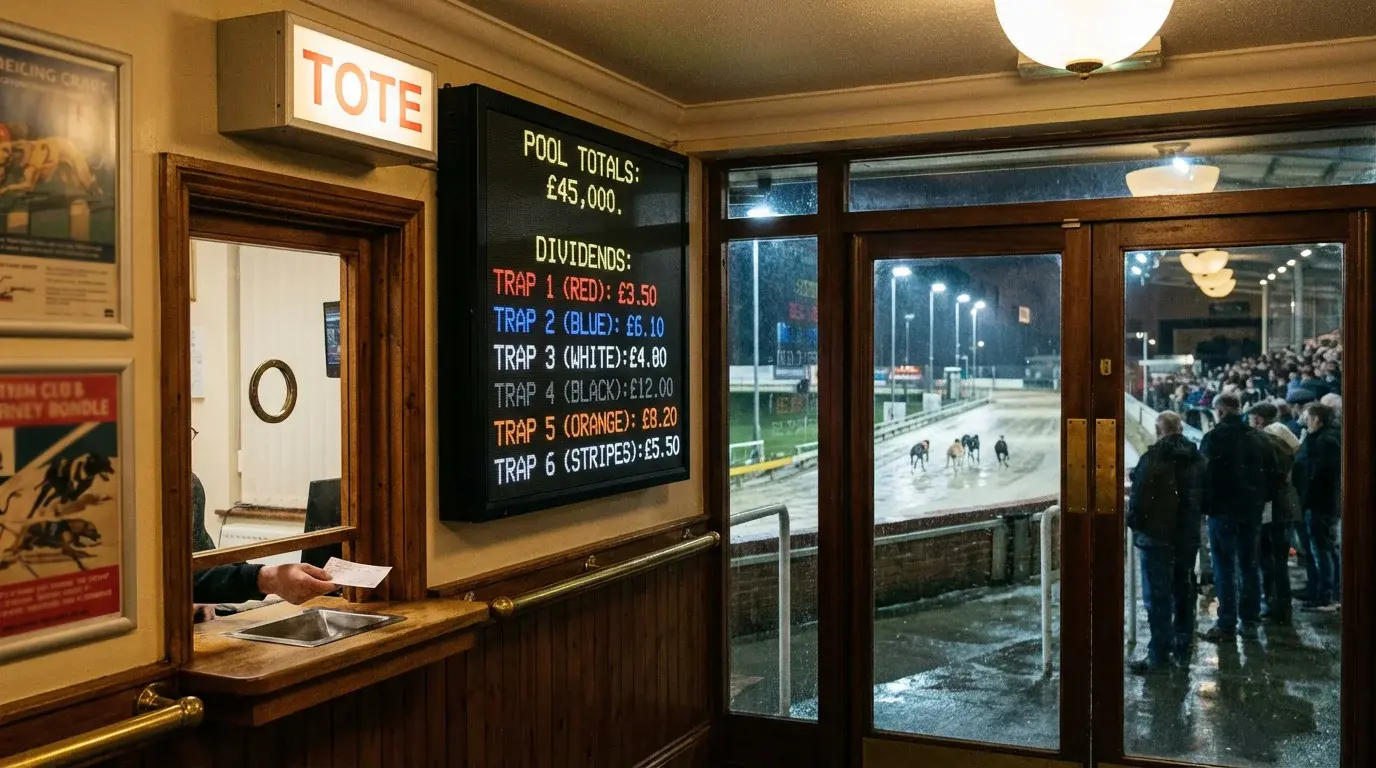
A Different Kind of Bet
Tote pools work differently from fixed-odds betting — and sometimes that difference pays. When you place a bet with a bookmaker at fixed odds, you know your potential return the moment you confirm the wager. The odds are locked in. If you back a dog at 5/1, you receive 5/1 regardless of what anyone else bets. Tote betting operates on a fundamentally different principle: your money goes into a shared pool with every other punter backing a result in the same race, and the payout is determined by how that pool is distributed after the result. You don’t know your exact return until the race is over.
This pool-based system has been part of greyhound racing since the sport’s earliest days in Britain, and it remains available at every licensed track and through online Tote platforms. For most punters, fixed-odds betting with a bookmaker is the default. But the Tote offers specific advantages in specific situations — and during the English Greyhound Derby, those situations arise more frequently than many bettors realise.
Compare with exchange betting in exchange betting on racing.
How the Tote Pool Works
The mechanics are straightforward. Every stake placed into a Tote pool on a specific race is combined into a single fund. The Tote operator takes a deduction — typically between 15% and 25% depending on the pool type — to cover operating costs and margin. The remaining money is then divided among the winning ticket holders in proportion to their stakes. If the total pool is £10,000, the deduction is 20% (£2,000), and the remaining £8,000 is shared among everyone who backed the winning dog.
The payout — called the dividend — is expressed as a return per £1 staked. If £8,000 is distributed among punters who staked a combined £2,000 on the winner, the dividend is £4.00 (equivalent to 3/1 in fixed odds). If only £500 was staked on the winner, the dividend rises to £16.00 (equivalent to 15/1). The less money staked on the winning outcome, the higher the dividend. This is where Tote betting can offer value that fixed odds cannot: if a dog wins at a price the public didn’t expect, the Tote dividend can significantly exceed the bookmaker’s starting price.
The main Tote pool types available on greyhound racing are the Win pool (back the winner), the Place pool (back a dog to finish in the first two), the Exacta (predict first and second in the correct order), the Trifecta (first, second, and third in order), and the Jackpot or Placepot pools that span multiple races on a card. Each pool type has its own deduction rate and its own dividend structure.
Win pool deductions are typically the lowest — around 15% to 18% — making the Win pool the most efficient Tote bet in terms of value returned to punters. Place pool deductions are slightly higher. Exacta and Trifecta deductions can reach 25% or more, reflecting the complexity of the bet and the smaller pool sizes. For Derby betting, the Win and Exacta pools are the most commonly used, though the Placepot — which requires you to find a placed dog in each of several consecutive races — can offer substantial payouts on Derby round nights.
One critical difference from fixed-odds betting: Tote dividends are affected by late money. If a large sum is placed on a dog in the final minutes before the off, the pool shifts and the dividend for that dog decreases. This means Tote prices are fluid right up until the race starts, unlike fixed odds which are locked in at the time of your bet. If you take a Tote position early and the dog attracts heavy support before the off, your dividend will be lower than you might have anticipated. There’s no “best odds guaranteed” equivalent on the Tote.
When Tote Beats Fixed Odds
The Tote is most likely to offer superior value when the winning dog is relatively unfancied by the public. In a Derby heat where the majority of Tote money is concentrated on one or two short-priced favourites, a longer-priced winner produces a dividend that can exceed the bookmaker’s SP by a meaningful margin. This happens because the pool’s structure amplifies the returns for minority selections — the less popular the winner, the fewer punters share the pool.
Derby heats are particularly fertile ground for Tote value because the public tends to focus its money on one or two well-known dogs per heat, leaving the remaining runners lightly backed in the pool. If your analysis identifies a dog that the public is underrating — perhaps a dog from a smaller kennel, or one with form from a less high-profile track — the Tote can offer a better price than the bookmaker because the pool hasn’t attracted money for that selection.
Exacta and Trifecta pools can produce exceptional dividends in competitive Derby heats. A first-and-second combination that the public didn’t predict — say, the fourth and fifth choices in the betting filling the top two places — generates an Exacta dividend that can dwarf the equivalent forecast payout from a bookmaker’s Computer Straight Forecast. In open heats where several dogs have a realistic chance, the Exacta pool is worth checking alongside the fixed-odds forecast market.
Conversely, the Tote is poor value when the favourite wins. If the public has heavily backed one dog and it duly obliges, the Win pool dividend is diluted across a large number of winning tickets. The dividend in this scenario is often lower than the bookmaker’s SP — sometimes significantly so. If you’re backing a short-priced favourite in a Derby heat, fixed odds almost always offer better value than the Tote, because the bookmaker’s price isn’t affected by the weight of public money in the same way.
The Placepot deserves special mention for Derby round nights. A Placepot requires you to find a placed dog in each of six (or more) consecutive races. On a Derby card with eight heats, a Placepot spanning all eight requires eight successful selections — a tall order, but one that produces life-changing dividends when it lands. The structure of Derby heats, where quality is high and results are often predictable in the early rounds, makes the Placepot a more viable proposition than on a standard BAGS card. Building a Placepot with bankers in the easier heats and permutations in the harder ones is a strategy that experienced Tote bettors use specifically on Derby nights.
Pooling Your Knowledge
The Tote isn’t better or worse than fixed-odds betting. It’s different. It rewards different situations, punishes different mistakes, and offers value in different places. The sharp bettor uses both — fixed odds when backing favourites or when price certainty matters, and the Tote when backing selections that the public has overlooked. During the Derby, with its high-quality fields and engaged public betting patterns, the Tote pools are deep enough to produce meaningful dividends and frequent enough to reward punters who check both markets before committing their stake.
Check the Tote price alongside the fixed odds on every Derby bet you consider. If the Tote is offering better value on your selection, take it. If not, stick with the bookmaker. The extra thirty seconds of comparison costs you nothing and can add meaningful value across a six-week competition.
Find all tote betting guides on the greyhoundderbybetting homepage.
