Greyhound Running Styles Explained
 Available in US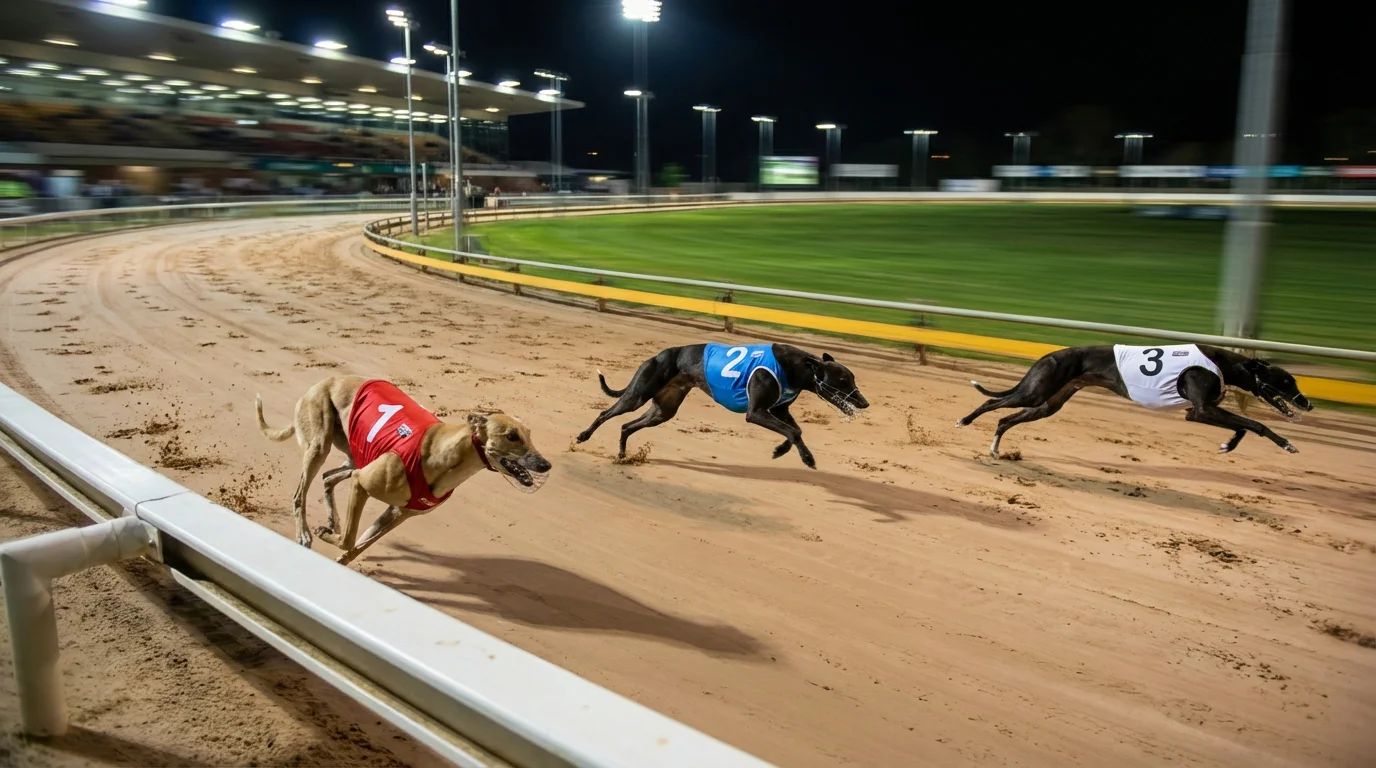
Every Dog Has a Signature
Every greyhound has a signature — early pace, late surge, rail preference. Spot it and you’re halfway to the bet. Running style is one of the most important and least discussed variables in greyhound betting. Two dogs can post identical finishing times over the same distance and still be fundamentally different athletes: one blazing to the front from the traps and holding on, the other sitting mid-pack through the early stages and producing a sustained run in the closing straight. Their form figures might look similar. Their race footage tells completely different stories. And the difference between those stories has direct implications for how each dog will perform in the specific context of a Derby heat at Towcester.
Running style isn’t fixed in the way that weight or breeding is fixed. It’s a behavioural tendency — a preference for how the dog races, shaped by temperament, training, and physical build. Some dogs are hard-wired front-runners that need to lead. Others are natural closers that only produce their best acceleration in the final 100 metres. Most sit somewhere between the extremes, adapting their running to the pace of the race and the position they find themselves in after the first bend. Identifying each dog’s style — and understanding how that style interacts with the draw, the track, and the opposition — is the foundation of sophisticated greyhound analysis.
Factor in weather and track when assessing running styles in weather and track conditions.
The Five Running Styles
Front-runners are the most visually compelling greyhounds to watch. They break fast from the traps, establish the lead before or at the first bend, and attempt to maintain that position to the finish line. Their weapon is early pace — the ability to reach racing speed faster than anything else in the field. The strongest front-runners don’t just lead; they dictate. They set the pace, choose the racing line, and force every other dog to chase. In a six-dog race, the front-runner has a significant tactical advantage: it runs the shortest route (on the inside rail), encounters no traffic, and can see the hare without obstruction.
The vulnerability of front-runners is stamina. Running at maximum speed from the off is physically demanding, and over 500 metres at Towcester — with four bends to navigate — even the quickest dogs can tire in the closing stages. Front-runners are also vulnerable to interference at the first bend if another dog challenges for the lead. Two front-runners in the same race frequently compromise each other, creating opportunities for dogs with more patient running styles to inherit the lead.
Closers are the opposite archetype. They begin conservatively — often deliberately so — and rely on a sustained burst of acceleration over the final 100 to 150 metres to overhaul the leaders. Closers are typically dogs with exceptional raw stamina and a finishing kick that allows them to maintain speed through the final bend and up the straight while dogs around them are decelerating. The greatest Derby closer was Westmead Hawk, whose come-from-behind victories in the 2005 and 2006 finals were textbook demonstrations of the style at its most dramatic.
The risk with closers is that they leave themselves too much to do. A closer that settles in fifth through the first three bends may have overtaking to accomplish that isn’t physically possible if the leaders have run a fast, even pace. Closers are also dependent on clear running at the crucial moment — if they’re boxed in or blocked at the final bend when they need to accelerate, the opportunity evaporates. The best closers combine finishing speed with tactical intelligence, finding the right moment and the right line to make their move.
Middle-run dogs are the tacticians. They don’t lead and they don’t trail. They sit in second, third, or fourth position through the early stages, maintaining contact with the leader without burning energy, and then shift up a gear through the third and fourth bends. Middle-run dogs are versatile — they can adapt to fast or slow paces, and they’re rarely compromised by the draw in the way that extreme front-runners or closers can be. In the Derby, where every round presents a different combination of opponents and trap draws, middle-run dogs tend to qualify consistently because they’re rarely out of position.
Railers are dogs that prefer to race on the inside rail, regardless of their early-pace characteristics. A railer doesn’t have to be a front-runner — it can be a mid-pack runner that gravitates toward the rail and uses the shortest path around the bends to save ground. Railers benefit from inside trap draws (traps 1 and 2) because they can establish their rail position early. From wider traps, railers face the challenge of crossing inward across the field before the first bend, which risks interference with dogs on their inside.
Wide runners take the opposite approach, racing on the outside of the pack and using the wider path around bends to avoid the congestion that builds up on the rail. Wide runners need more raw speed to compensate for the extra distance they cover — the outside path around four bends adds meaningful yardage to the total race distance. At Towcester, where the bends are wider than at most British tracks, the penalty for running wide is less severe than at tighter circuits. This makes Towcester a comparatively more friendly venue for wide-running greyhounds, and it’s one reason why dogs that struggle at compact tracks like Romford or Crayford sometimes find improvement when they switch to the Derby venue.
Style Meets Track: Running at Towcester
Towcester’s layout interacts with running styles in specific ways that Derby bettors should understand. The long run of approximately 80 metres to the first bend favours dogs with early pace, because they have more time to establish position before the first turn. At tracks with shorter runs to the first bend, front-runners from wide traps can be compromised because they can’t reach the rail before the bend arrives. Towcester gives them the time and space to cross, which reduces the inside-trap advantage for front-runners and makes early pace from any draw a viable tactic.
The wide bends are the defining characteristic for running-style analysis. They spread the field, which benefits both railers and wide runners — the railer can hold its line without being squeezed by dogs cutting in, and the wide runner has room to maintain speed around the outside without being pushed to the boards. At tighter tracks, the bends compress the field and force dogs into closer proximity, which increases interference and gives railers a sharper advantage. Towcester’s geometry is more democratic: style matters, but no single style has an overwhelming structural advantage.
The 500-metre distance includes four bends, and the balance between straight-line speed and bend ability is roughly even. Front-runners who maintain pace through bends will prosper. Closers who struggle on bends but accelerate on straights may find the bend-heavy layout less accommodating. The optimal Towcester dog — in stylistic terms — is one that combines early positional speed with the ability to sustain pace through four turns and finish strongly up the home straight. Dogs with this profile tend to be middle-run types that can lead or sit handy and kick through the final 150 metres.
The sand surface adds a stamina element that interacts with running style. Sand is more demanding than harder surfaces, and the physical toll increases over the course of a race. Front-runners that expend maximum energy in the first 200 metres may feel the sand most acutely through the closing bends. Closers, who conserve energy early, may find the surface suits their style — they have more in reserve when the leaders are beginning to tire. On wetter evenings, when the sand becomes heavier, this stamina differential increases, and closer-type running styles gain a relative advantage.
Style Is Strategy
Identifying a dog’s running style isn’t an end in itself. The value lies in using that identification to assess how the dog will perform in a specific race against specific opponents. A front-runner drawn in trap 1 against five closers is in an ideal scenario — it leads uncontested and controls the race. The same front-runner drawn against two other early-pace dogs faces a first-bend battle that could compromise all three of them and hand the race to a patient closer drawn wide.
In the Derby, where the draw changes every round and the opposition varies with each stage of the competition, the interaction between style, draw, and opponents is the richest seam of analytical value available. Two dogs can have identical form figures and identical times, but if one is a front-runner drawn against two rival speedsters and the other is a closer drawn against a field of mid-pack runners, their actual chances of winning the race are very different. The form doesn’t distinguish between them. The style analysis does.
Watch the replays. Note the styles. And when the draw is published for each round, map the styles onto the traps. That’s where the real Derby analysis begins.
Analyse greyhound running styles on the greyhoundderbybetting homepage.
