In-Play Betting on Greyhound Races
 Available in US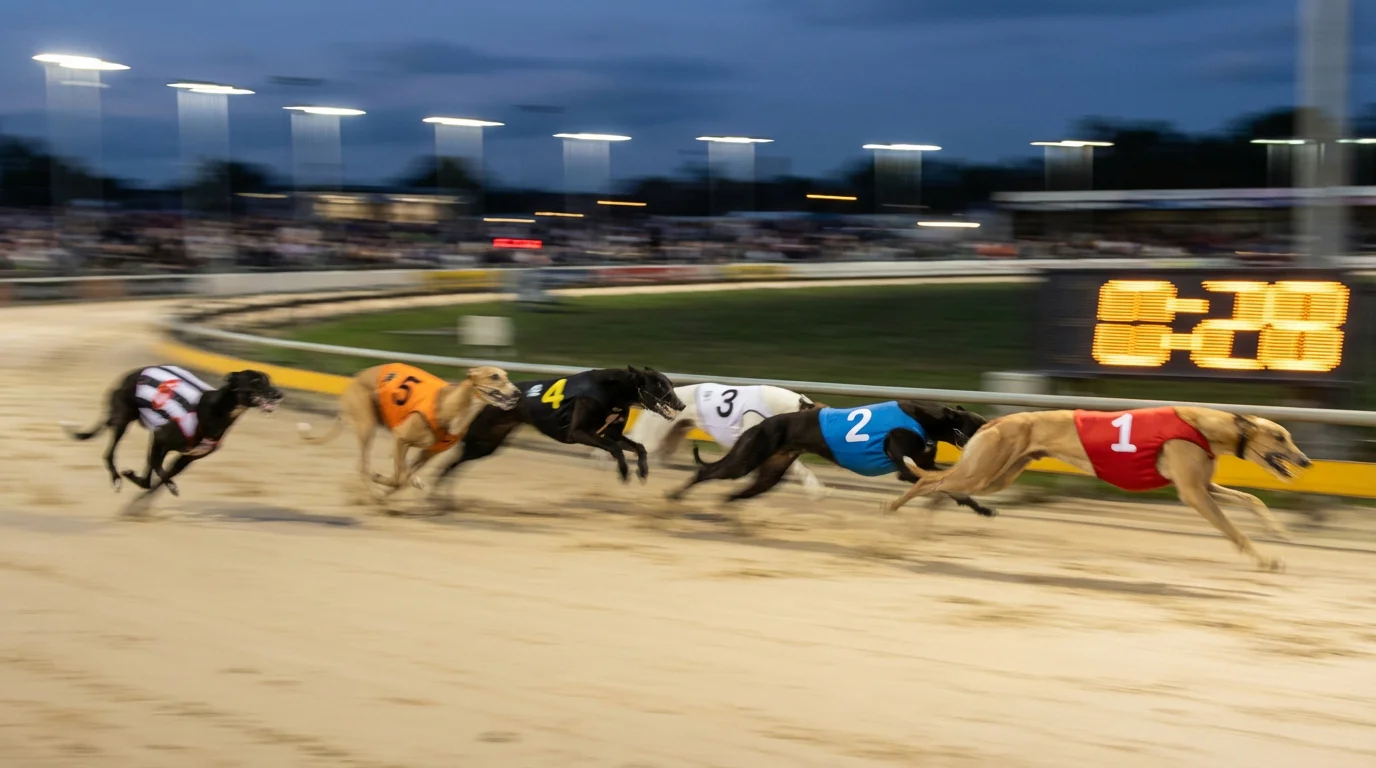
Thirty Seconds of Opportunity
Greyhound in-play lasts 30 seconds. Every one of them matters. A 500-metre greyhound race at Towcester is over in roughly 29 seconds. From the moment the traps open to the moment the first dog crosses the line, the in-play market is live — and by the time most punters have processed what’s happening on the track, it’s already being settled. In-play betting on greyhound racing is the fastest form of live wagering in any sport. It compresses the entire decision-making process — observation, analysis, execution — into a window that barely lasts half a minute.
That speed is both the attraction and the danger. For punters with the ability to read a race as it unfolds — identifying which dog has the lead at the first bend, which is trapped wide, which has found clear running — in-play offers opportunities to back or lay at prices that reflect the live situation rather than the pre-race market. A dog that stumbles from the traps might drift from 2/1 to 6/1 within two seconds of the off, offering value if you believe the dog can recover. Conversely, a front-runner that blazes to the first bend might shorten from 3/1 to 4/6 in the same window, offering a chance to lay at a price that overestimates its ability to hold on through the final bend.
But the margin for error is essentially zero. There’s no time to deliberate. No time to consult the form book. No time to watch a replay and reconsider. In-play greyhound betting rewards instinct, pattern recognition, and pre-race preparation — the work you do before the traps open determines whether your 30-second window produces a sharp bet or a panicked one.
Watch live to inform your in-play bets in live streaming.
How In-Play Greyhound Markets Work
In-play greyhound markets operate differently from pre-race markets in several important respects. The pricing is generated algorithmically, typically based on live positional data fed from the tracking system at the stadium. As the race progresses, the algorithm updates the odds of each dog based on its current position, the distance remaining, and historical patterns of how races at that track and distance tend to develop. This means the in-play prices are reactive rather than predictive — they reflect what is happening, not what the market thinks might happen.
The available bet types during in-play are typically limited to win markets. Forecast, tricast, and each-way bets are not usually available in-running because the speed of the race makes it impractical to offer and settle these more complex markets in real time. Some bookmakers also restrict in-play greyhound betting to their exchange platform rather than their sportsbook, particularly for less high-profile meetings. On the exchanges, you can both back and lay in-running, which opens up trading possibilities — but the liquidity on greyhound in-play exchange markets is thin compared to horse racing, especially outside the biggest events.
The speed of market settlement is a distinguishing feature. In-play bets on a greyhound race are settled within seconds of the result being confirmed. There’s no photo-finish wait comparable to horse racing. The winning dog crosses the line, the result is declared, and your bet is settled. For punters using in-play as part of a broader strategy — perhaps hedging an ante-post position or covering exposure on a specific heat — this rapid settlement means you can immediately assess your overall position and adjust for the next race on the card.
Latency is the hidden variable that determines whether in-play greyhound betting is viable for any individual punter. Latency refers to the delay between the live action and what you see on your screen. If you’re watching a stream with a two-second delay and the in-play prices are updating in real time, the prices you see on screen may already reflect action you haven’t witnessed yet. A dog that fell at the third bend might have already caused the market to suspend by the time you see the incident on your stream. This latency gap is unavoidable for remote punters — the only way to eliminate it is to be trackside, which puts you inside the same informational loop as the pricing algorithm.
Most bookmakers manage this by including a slight delay on in-play bet acceptance — your bet request goes into a queue and is accepted or rejected based on the market state at the moment of processing, not at the moment of submission. If the market has moved significantly between your click and the processing, the bet may be rejected or offered at a revised price. During a 29-second greyhound race, this process happens multiple times. If your connection is slow, your acceptance rate will suffer.
Minimum and maximum stakes on in-play greyhound bets tend to be restrictive. Bookmakers are aware that the speed of greyhound races creates opportunities for exploitative in-play betting (particularly from punters with low-latency access to live pictures), and they manage this risk by limiting liability. Don’t expect to place large stakes in-running on individual greyhound races unless you’re on an exchange where another participant is willing to match your bet.
In-Play on Derby Nights
The Derby adds layers of complexity and opportunity to in-play greyhound betting. Derby heats are six-dog races featuring some of the highest-quality greyhounds in Britain and Ireland, running on a track with specific characteristics that influence how races develop. The combination of elite fields and Towcester’s track geometry creates patterns that in-play bettors can learn to recognise.
The run to the first bend at Towcester is long enough — around 80 metres — that early pace is a genuine differentiator. Dogs that break fast from the traps and hit the first bend in front tend to have a significant advantage at Towcester, because the bend geometry rewards dogs that establish position early. In-play prices reflect this: a dog that leads at the first bend will shorten dramatically, while a dog that’s bumped or slow away will drift. The question for in-play bettors is whether the market overreacts to first-bend position. A strong closer drawn on the outside might be 10/1 in-running after a slow start, but if you know its running style is to come from behind and you’ve watched it do exactly that in previous rounds, 10/1 might be value.
Derby heats also feature higher-quality fields than standard BAGS racing, which means the margins between dogs are tighter. A dog that leads by two lengths at halfway might hold on to win in a standard A2 race, but in a Derby heat the closers behind it are faster and more experienced. In-play prices on the leader might be too short if the algorithm is basing its assessment on general Towcester race data rather than the specific quality of the chasing pack in a Derby heat. This creates a nuanced edge for punters who understand the competition’s standard — though acting on it within a 29-second window requires preparation and confidence.
From a practical perspective, in-play Derby betting works best as a complement to pre-race positions rather than a standalone approach. If you’ve backed a dog ante-post and it reaches the semi-final, you might use in-play to hedge your position during the race — laying the dog in-running at shorter odds to lock in a profit regardless of the result. If your pre-race selection breaks slowly and drifts to a big price in-running, you might choose to add to your position at the enhanced odds if you still believe the dog can run into a place. These are reactive decisions that extend your pre-race analysis into the live environment.
The Speed Game
In-play greyhound betting strips away everything except the essentials: what you see, what you know, and how fast you can act. There’s no bluffing, no waiting for the market to come to you, no luxury of a second opinion. The race happens. The market moves. You’re either in position or you’re not.
For most punters, in-play greyhound betting should be a small, controlled part of their Derby approach — a tool for specific situations rather than a primary strategy. The latency disadvantage alone makes sustained profitability from remote in-play betting extremely difficult. But for selective use — hedging an ante-post position, capitalising on a known running style at an inflated in-play price, or taking a view on a specific dog at a specific bend — in-play adds a dimension to Derby betting that no pre-race market can replicate.
Preparation is everything. Know the dogs. Know the track. Know your own latency. And when the lids rise, trust the work you did before the race rather than the adrenaline flooding through you during it.
Find all in-play Derby betting guides on the greyhoundderbybetting homepage.
