Tricast Betting on the Greyhound Derby
 Available in US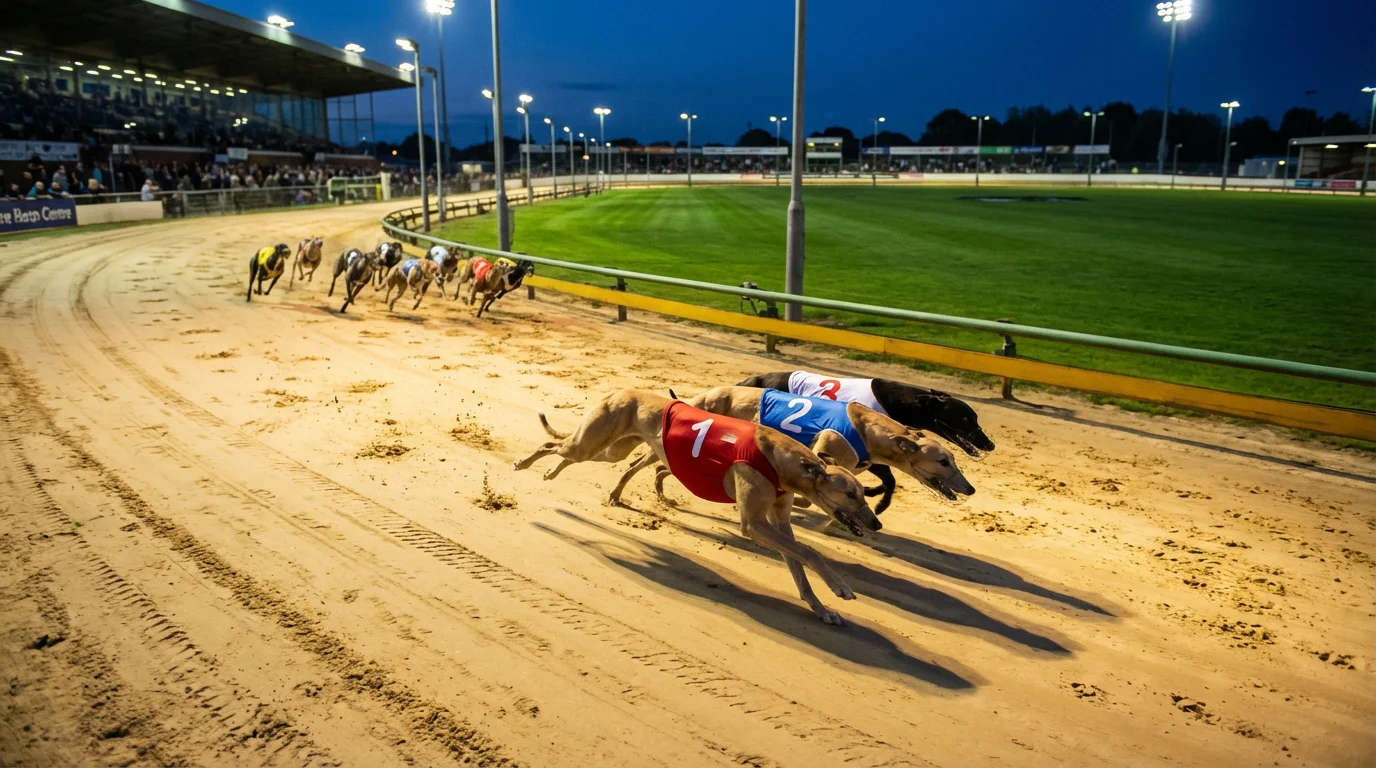
Twenty Combinations, Six Dogs
Twenty possible combinations. Six dogs. The maths is friendlier than you think. A tricast asks you to predict the first three finishers in a greyhound race in the exact order. In a twelve-runner horse race, that’s a combinatorial nightmare — 1,320 possible outcomes. In a six-dog greyhound race, the number drops to 120 for the full permutation set, and to just 20 for a straight tricast where you name your three specific dogs in order. That’s the structural advantage of greyhound tricast betting: the field size makes an inherently difficult bet significantly more achievable.
In the English Greyhound Derby, tricasts occupy a distinctive niche. The competition’s deep form book — you can watch every dog race at Towcester across multiple rounds — gives serious punters enough data to construct informed tricast selections rather than relying on guesswork. And because the Derby attracts significant betting interest, the tricast pools (or calculated dividends, depending on the bookmaker) tend to be liquid and well-priced. A well-judged Derby tricast can return eye-catching sums even at modest stakes.
But let’s be clear about the difficulty. Predicting the exact one-two-three in order is hard. It’s harder than a win bet, harder than a forecast, and harder than most punters care to admit. The question is whether the potential returns compensate for that difficulty, and in which specific Derby situations the answer is yes. The short version: in competitive heats with clear form differentials among the top three dogs, tricasts can be a potent edge. In open races where any dog could finish anywhere, they’re closer to a lottery ticket.
Compare with forecast bets in derby forecast bets work.
How Straight Tricasts Work
A straight tricast requires you to name the first, second, and third finisher in the exact order they cross the line. One combination, one bet. If you select Trap 4 to win, Trap 1 second, and Trap 6 third — those three dogs must finish in precisely that sequence for your bet to pay out. If Trap 1 wins and Trap 4 finishes second, with Trap 6 still third, you lose. There’s no partial payout for getting the right three dogs in the wrong order.
The dividend is calculated using the Computer Tricast formula, which considers the starting prices of all three dogs involved, the number of runners, and the market structure. The formula rewards combinations involving longer-priced dogs more generously than combinations of favourites. In a typical six-dog Derby heat, a straight tricast involving the three shortest-priced dogs in the field might return between £15 and £40 per £1 staked. Replace one of those dogs with a 5/1 or 6/1 shot and the return can climb to £80 or £100. If a genuine outsider fills one of the placed positions, three-figure dividends are common.
In a typical Derby first round, several heats produce straight tricast dividends above £150 for a £1 unit — driven by results where the second or third finisher was not among the leading fancies. In the later rounds, as the field quality equalises and prices compress, tricast dividends tend to moderate, though they can still significantly outperform forecast returns on the same races.
The analytical challenge of a straight tricast is threefold. You must assess the winner (who has the form and draw to lead or finish strongest), the runner-up (who is most likely to fill second without quite having the pace or position to win), and the third-place finisher (often the most difficult call, because this is where running style, bend positioning, and stamina interact most unpredictably). Each of these assessments draws on different aspects of the form book. A strong front-runner drawn in trap 1 might be your winner, but the runner-up might depend on whether the wide runner or the closer finishes more strongly through the final straight.
One practical approach for Derby heats: start with your predicted winner, then assess the remaining five dogs for likely finishing positions based on running style and draw. Dogs with similar styles drawn next to each other often interfere with one another at the first bend, which can compress or rearrange the expected finishing order. A closer drawn in trap 5 might benefit from trouble between traps 2 and 3, picking up second or third at a price the market didn’t expect.
Combination Tricasts: Broader Coverage, Higher Cost
If the straight tricast is a sniper shot, the combination tricast is a cluster munition. You select three or more dogs and cover every possible finishing order for the first three places. The coverage is comprehensive — but it comes at a price.
With three selections in a combination tricast, you’re covering six different finishing orders (3 factorial = 6 bets). That means a £1 combination tricast with three dogs costs £6. The good news is that as long as your three chosen dogs finish in the top three — in any order — you collect. The dividend is calculated on the actual finishing sequence that occurred. The cost is fixed regardless of order.
| Selections | Number of Bets | Cost at £1 Unit |
|---|---|---|
| 3 dogs | 6 | £6 |
| 4 dogs | 24 | £24 |
| 5 dogs | 60 | £60 |
| 6 dogs (full field) | 120 | £120 |
The cost formula is simple: multiply the number of selections by one less, then by one less again. For four dogs: 4 x 3 x 2 = 24 bets. For five: 5 x 4 x 3 = 60. You can see how quickly the costs escalate. A four-dog combination tricast is still practical at modest stakes — £0.50 per line gives you a £12 total outlay, which is reasonable if the potential dividend is in the hundreds. A five-dog combination at £1 per line costs £60, which begins to require very high dividends to be worthwhile.
In Derby heats, the three-dog combination tricast is the most popular variant. It works best when you’ve identified three dogs that you believe are clearly superior to the other three runners in the heat, but you’re uncertain about the exact finishing order among your trio. This is a common scenario in the first and second rounds, where the quality differential between the top three and bottom three can be pronounced. In later rounds — quarter-finals and semi-finals — the field quality is more uniform, and the chances of an outsider breaking into the top three increase, making combination tricasts riskier.
A hybrid approach can be effective: back your top three in a combination tricast (6 bets), then add one or two additional straight tricasts featuring an outside candidate in third place paired with your two strongest fancies in first and second. This gives you full coverage of your core trio plus targeted coverage of a specific upset scenario, at a fraction of the cost of a four-dog combination.
When a Tricast Pays and When It Doesn’t
Tricasts are a genuine weapon when three conditions align: the form clearly separates three dogs from the rest of the field, the likely finishing order can be estimated from running style and draw analysis, and the calculated dividend exceeds the cost of the bet by a meaningful margin. When those conditions hold — as they often do in early-round Derby heats — a well-constructed tricast offers one of the best risk-to-reward ratios in greyhound betting.
Tricasts become a vanity bet when the form offers no clear separation, when you’re guessing the third-place finisher rather than assessing it, or when you’re scaling up to four- or five-dog combinations purely to avoid making a decision. The cost of a five-dog combination tricast is £60 at £1 stakes. For that money, you could back ten different straight forecasts across two heats, or place multiple well-researched win and each-way bets. Every pound spent on unnecessary tricast coverage is a pound not spent on a more considered position elsewhere.
The Derby’s six-round structure also creates a temporal dimension to tricast strategy. In the first two rounds, when the field is large and the quality differential within heats can be significant, tricasts on the stronger heats are genuinely viable. By the semi-finals, the remaining 12 dogs are all high-class, the margins between them are tighter, and the probability of a straight tricast landing drops accordingly. The final — six of the best dogs in Britain and Ireland — is tricast territory only for the very bold or the very well-informed.
A useful rule of thumb: if you can’t articulate a specific reason why your predicted third-place finisher will beat the fourth-place dog, your tricast is a guess dressed up as analysis. The Derby rewards precision. Tricasts, used well, are the sharpest tool in the box. Used badly, they’re the most expensive.
Find all exotic bet guides on the greyhoundderbybetting homepage.
